It has now been 14 years since the last new name appeared on the list of drivers who have won sports car racing’s Triple Crown of major races: the Le Mans 24 Hours, the Daytona 24 Hours and the Sebring 12 Hours.
It is the longest period there has ever been with no new additions, which is rather ironic. The Grand-Am/ALMS merger in 2014, and then the introduction of common Hypercar/GTP regulations in 2023, have done a magnificent job of unifying the previously fractured sports car scene, not only facilitating the present boom in prototype racing, but also creating far better opportunities to achieve the Triple Crown than has been the case for many years.
History shows that it’s far easier said than done: a driver needs not only skill, a good car, competent co-drivers and luck, but also to be in a position to land competitive drives on both sides of the Atlantic. Accordingly, the list of Triple Crown winners is an unusual one, including some names that many would not expect to be there, and excluding some of the most famous and successful of sports car drivers. For instance, not one of the nine most successful drivers at Le Mans – the men who have won the race at least four times – have won the Triple Crown!
The first problem is one of definition. IMSA touted this year’s Daytona 24 Hours as the 62nd running, which means that it likes to regard the Three Hour, 2000km and Six Hour races in 1962-65 and 1972 as being part of the history of the 24 Hours.
There are arguments for and against that approach, but the significance for present purposes is that Dan Gurney, Phil Hill and Jacky Ickx only appear in the list of ‘Triple Crown’ winners if their “short Daytona” wins in these races are counted. Even within those five races, there is a big qualitative difference between the 2,000km races, which lasted about 13 hours, and the two Three Hour races. In any event, it is my opinion that winning those “short Daytona” races is not the same as winning the 24 Hours, so those three drivers have not been included in the table below.
That being so, the first man to achieve the Triple Crown is also perhaps the first surprise. Hans Herrmann did not have the reputation for blistering speed which was the hallmark of his contemporaries like Pedro Rodriguez, Jo Siffert and Vic Elford – but then again, his name is on the list and theirs aren’t.

Famously, when Porsche was assembling its squad for 1970 Le Mans, Richard Attwood told them that he wanted the dependable Herrmann as his co-driver. It was an inspired choice, allowing Herrmann to gracefully retire after that race, having driven Porsches to victory in all three of these classic races.
Even before Herrmann completed his Triple Crown, Jacky Ickx and Jackie Oliver had a better chance than most drivers before or since (well, apart from Ken Miles) of winning the three races in the same year, which really would’ve been something.
Daytona ’69 was a race of high attrition which everyone did their level best to lose, Ickx’s contribution being to thump the wall on the banking in the Ford GT40 he shared with Oliver, when well placed to win the race. Better fortune awaited them later in the year at Sebring and especially Le Mans, both of which they won in the famous chassis 1075. Oliver duly collected the Daytona win in a Gulf Porsche 917 two years later.
Hurley Haywood has the distinction of winning more Triple Crown races (10) than anyone else who has won all three. This opportunity came about because he not only had the works Porsche drive in Europe (leading to those nerve-shredding victories at Le Mans in 1977 and 1983, plus the win in the largely-forgotten 1994 race) but also with a series of Porsche-affiliated teams, such as Brumos, in America.
Still, it’s one thing to have the opportunity, but another to achieve the results: Haywood was an impressive frontrunner in America for more than 20 years, won Daytona five times and Sebring twice, and remarkably finished third at Daytona as recently as 2009, when he was 60.
Haywood had built much more of a career in road racing before winning Le Mans than had the second American on the list, the legendary A.J. Foyt. The big Texan made a good fist of it when called up to join the famous Ford programme in 1966. Even so, not many people thought that he and Dan Gurney were likely winners at Le Mans ’67.
But Foyt won that historic race from the front, including doing an extra stint when, he colourfully told Autosport years later, it “was raining like hell and I came in to hand over to Gurney. Well, they couldn’t find that son of a bitch anywhere so off I go for another stint. Hell, he was sitting somewhere nice and dry, and he ain’t no fool”.
Like that stint, Le Mans was Foyt’s high-water mark in sports cars. He won at Daytona in 1983 in rather odd, unconvincing fashion after starting, and retiring, a Nimrod, then transferring to a Porsche 935 in the small hours of Sunday morning, much to the annoyance of its incumbent, Bob Wollek. Nevertheless, Foyt and Wollek again paired to win Daytona (with a lot of help from others, notably Thierry Boutsen) and then Sebring in 1985, and also twice finished second at Daytona.
Foyt was 50 when he completed the Triple Crown in 1985, to go with those four Indianapolis 500 wins and numerous other USAC titles. His road racing credentials extend beyond the Le Mans win, and are far stronger than many people realise.
And looking at the racing longevity of Haywood and Foyt, it only accentuates what their compatriot Al Holbert may have achieved if he hadn’t been killed in a plane crash when aged 41. In his last two full seasons of racing in 1986-87, Holbert came close to winning all three Triple Crown races in the same year: each time, he won Daytona and Le Mans, but was third at Sebring in 1986 and second in 1987. But he’d previously won Sebring twice, so his Triple Crown was already secure.
Andy Wallace had a great chance at winning the Triple Crown in the Hans Herrmann style by driving for a company, in this case Jaguar, which had a racing programme in both Europe and America.
Wallace was part of the epic Jaguar win at Le Mans in 1988, and also won Daytona for TWR and the big cat in 1990. But he never won Sebring for Jaguar, so didn’t complete his Triple Crown until he was driving for Dan Gurney’s Eagle team in 1992.

Mauro Baldi, who had been one of Hurley Haywood’s co-drivers in the 1994 Le Mans win, started 1998 with a flourish by winning both Daytona and Sebring in a Ferrari 333SP. But just as his 1994 win in the Dauer had been achieved by stretching the rules to allow a thinly-disguised Porsche 962 into the race, so it was that in 1998 the GT1 cars no longer bore much resemblance to what could be considered GT road cars. The LMP1 cars like the Ferrari essentially had no chance at Le Mans, and Baldi trailed home 14th.
It is also a surprise to see Marco Werner’s name on the list of Triple Crown winners, not because of any lack of ability, but because of the era in which raced. He was closely associated with Audi’s steamroller campaign, but the big Ingolstadt names like Kristensen, Capello, McNish, Pirro and Biela do not appear on the list of Triple Crown winners, because Audi only ran in the ALMS (which included Sebring), but not Grand-Am (which included Daytona). In other words, that generation of drivers had little practical chance of landing the Triple Crown.
That didn’t stop some of them from trying. Werner had obtained a drive in a Porsche-assisted Kremer at Daytona in 1995, which claimed a good win. McNish had finished second at Daytona twice in the pre-Audi era, 1998 and 1999, then obtained a leave pass to have another shot at the race in 2012 (just like some of the WEC Toyota drivers do to this day). McNish yet again finished second that year, although this time on the lead lap as the winner.
So without the cherished Daytona triumph, McNish couldn’t win the Triple Crown, but for Werner, his 1995 Daytona win meant it was now more a question of which of the Audi crews were going to win the long string of Sebring and Le Mans classics which the four-ringed marque contested. The cards fell rather well for Werner, as he won three of each.
Marco Werner was perhaps not as well-known as some of his illustrious Audi colleagues, but not only did he win the Triple Crown, but amongst those who did so, only Hurley Haywood won the three famous races more often.
Timo Bernhard is the most recent driver to win the Triple Crown, which he completed in 2010. Unlike many of the other drivers who have achieved the feat, his four Triple Crown race wins have all come from positions of considerable adversity.

At Daytona in 2003, his Porsche GT3 RS was only 16th on the grid, five secs off the pole. They quickly made their way through the field in the early running, although Bernhard later commented he was surprised that the followers weren’t closer: they won by a useful nine laps.
Better was to follow. At Sebring in 2008, Bernhard (Porsche RS Spyder) won one of the very few outright victories for an LMP2 car in the ALMS, defeating the LMP1 Audis and Peugeots.
At Le Mans two years later, he yet again found himself with a speed deficit, this time in an Audi R15. The much quicker Peugeots initially disappeared up the road, and then just disappeared altogether. With all the 908s gone, Bernhard, Dumas and Rockenfeller took a classic old-style endurance race win, setting a distance record that still stands to this day.
Finally, at 2017 Le Mans, Bernhard’s Porsche 919 ran into hybrid problems early in the race. After long repairs, Bernhard/Bamber/Hartley found themselves a mere 17 laps from the lead, with a lot of good cars in between. They were no closer to the front at the 18-hour mark. Six hours later, they’d won the race, the Toyota attack having collapsed, and the sister Porsche having expired with its enormous, but now futile, lead still intact.
In the 14 years since Bernhard completed his Triple Crown, Sebastien Bourdais has gone closest to joining the club: he’s won Daytona and Sebring, and has three times been second at Le Mans, including that agonising defeat by just 14 secs in the epic 2011 race.
But history is packed with drivers who have almost won the Triple Crown. Most famously, Ken Miles missed out by fractions of a second at Le Mans ’66, in a controversial, mysterious finish which has been discussed at length on this website and in countless other places. (Indeed, that controversy largely obscured the fact that Ford had just become the first manufacturer to win the Triple Crown; remarkably, only four other marques have followed in Ford’s wheel tracks.)
And there are a lot of very good drivers other than Miles, Bourdais and McNish who have won two legs of the Triple Crown and been second in the third leg. For instance, Derek Bell is one of the most successful sports car drivers of all time, but his name isn’t on the Triple Crown list: he won Le Mans five times and Daytona three times, but frustratingly could only muster four second places at Sebring.

Other leading drivers to narrowly miss out on winning the third leg of the Crown include Lorenzo Bandini and Chris Amon (who led Ferrari’s defiant thumbing-their-nose-at-Ford 1-2-3 at Daytona in 1967), Ludovico Scarfiotti, Geoff Brabham and Oliver Jarvis.
And in an inspiration to gentleman drivers everywhere, “John Winter” (Louis Krages) backed up his win at Le Mans in 1985 (achieved by virtue of the noble, selfless art of doing a couple of quiet stints, mostly under safety car, while Klaus Ludwig and Paolo Barilla did all the heavy lifting the rest of the way) with a Daytona triumph in 1991, and a second place at Sebring in 1988.
Such opportunities for a gentleman driver are long gone. The best chance of a current driver landing the Triple Crown lies with those who are driving for manufacturers taking advantage of the uniform prototype regulations in both IMSA and WEC.
Take the 2023 season, for instance. Earl Bamber, with Le Mans and Sebring victories already under his belt, had a good shot at the Daytona win in a Cadillac. Sebastien Bourdais’ Cadillac contract gave him a frontline drive at Le Mans for the first time since the Peugeot LMP1 era, while his fellow Daytona and Sebring winner Pipo Derani also went to Le Mans with a far better chance of winning it than ever before.
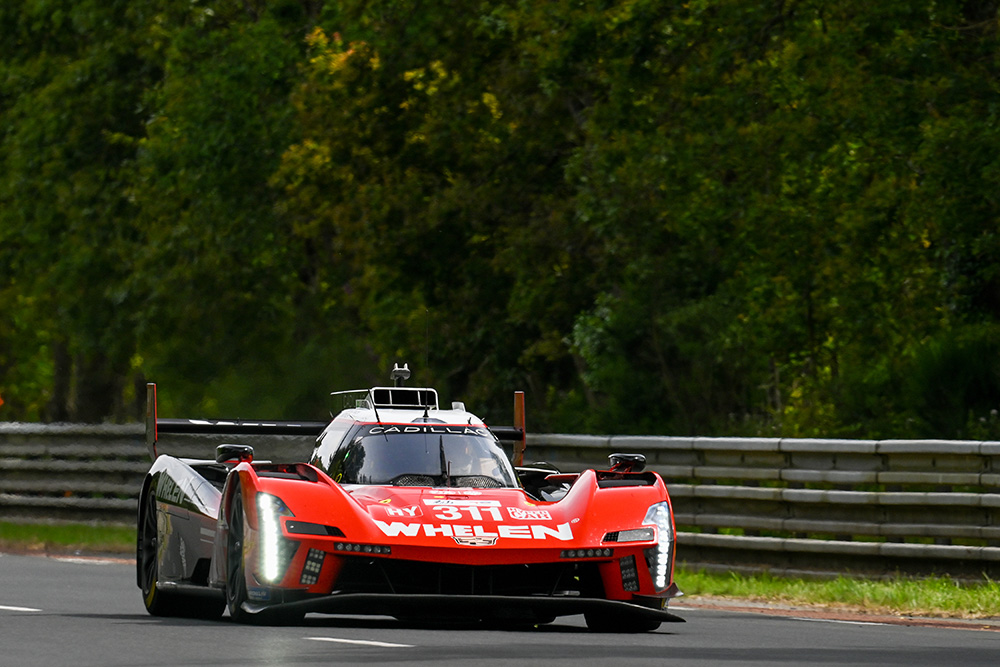
The trend is only enhanced in 2024, as BMW and Lamborghini join the list of dual WEC/IMSA outright contenders. Other marques are likely to follow in coming years.
Winning the Triple Crown has never been easy. The nine men who have won it are a select, if unusual, group. But the uniform prototype regulations have opened the doors, and it won’t be long before the group acquires its tenth member.