


McLaren is still considering entering the Hypercar ranks as a manufacturer in the future, following the ACO and FIA’s decision to extend the current ruleset by two years to the end of the 2029 FIA WEC season.
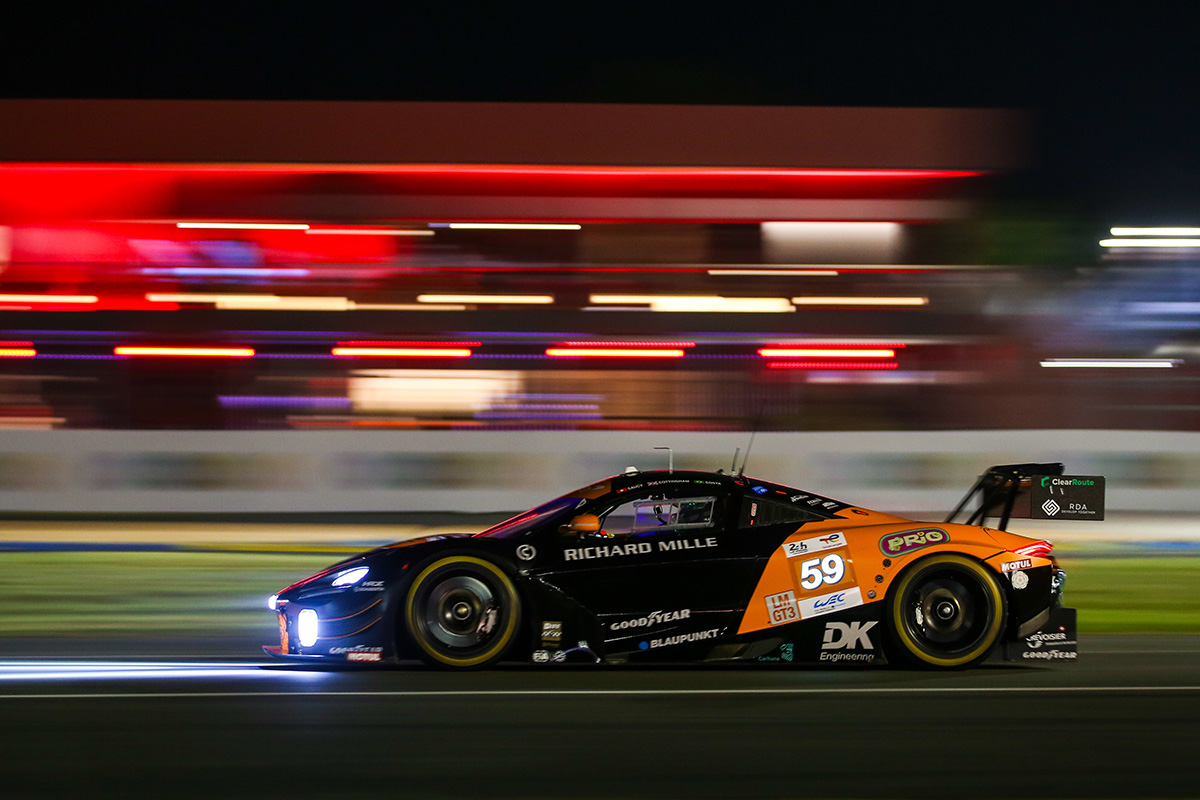
The Woking-based brand, fresh from its return to the Le Mans 24 Hours with a trio of LMGT3 Evos, welcomes the decision to extend the homologation period.
Zak Brown, McLaren Racing’s CEO, says it has provided the manufacturer with enough time to make a final decision on a programme in the coming months, develop a car and have it racing in time for the 2027 season. This would give it at least a three-year period to compete.
“I think cost in all motorsport is critically important and I think the extension definitely helps our business model that we have laid out internally. ‘If’ and I’d like to say it’s more ‘when’ than if we step up to the top class, the extension is favourable,” Brown told reporters alongside McLaren CEO Michael Leiters in a round table discussion last week at the Circuit de la Sarthe.
“It gives us more breathing space because you wouldn’t want to enter a championship in its last season.”
McLaren has been keeping an eye on the current ruleset for a number of years and is believed to have come close to signing off a programme on multiple occasions. So, leaving the ruleset extension to one side, what if anything has changed to tip the scales this time?
Brown explained that McLaren Racing’s Formula One, IndyCar, Formula E and Extreme E programmes are now all delivering standout results. The team is also in a better place financially now than in years past.
“We think it (a Hypercar programme) would be great for the brand. We love sportscar racing, we have a lot of stuff going on in our business. On the racing side, we needed to get our Formula One team back to the from and it is now very close. Our IndyCar team is also strong,” he continued.
“We need to make sure that if we take on another project it doesn’t disrupt our activities. I think we are not far away from feeling comfortable and I think we could take on another project without diluting our Formula One team, our IndyCar team or electric racing.
“We are turning a profit. McLaren Racing is very healthy. So then it’s just about timing. It takes a couple of years to get ready, so if you were going in 2026 you’d need to make a decision tomorrow, and we are not going to make one tomorrow. It’s just about getting our businesses aligned. But I think the excitement is there.
“I think you are looking at 2027 at the soonest.”
The engine regulations also proved a sticking point in the past, as the crank on its current V8 is too high. But Leiters dismissed the idea that engine choice would be a barrier this time.
“First we have to take a decision on when and how to do that (the programme) and then we come to the engine,” he said. “It would be perfect to have an engine in line with the road car programmes, that would be the dream. But then we would never compromise anything for competitiveness.”
Should McLaren bite the bullet and sign off a Hypercar programme, putting it in contention for an overall Le Mans victory for the first time since 1998, what would it look like?
Brown was clear that the LMDh ruleset remains the most appealing option. He also confirmed that the new ‘two-car’ rule for manufacturers wouldn’t be a sticking point because it would be “the right business model and not an issue.”
As for the team that would operate the cars in the WEC, it is too early to say which outfit would get the nod; though you could reasonably expect that United Autosports – which competes with McLaren in the WEC’s LMGT3 class – would be a frontrunner due to its desire to compete in Hypercar, its level of capacity and resource and its connection to McLaren via Zak Brown, who co-owns the team along with Richard Dean.

Other burning questions, surrounding McLaren’s interest in IMSA GTP and customer cars, were also asked in the round table.
On the subject of running a parallel US-based programme, Brown simply said: “I have no idea, I don’t know.”
Customer cars do not appear to be on the current agenda as a key part of a potential effort either.
“Our current business plan would be us going racing as a works team,” Brown explained. “I think if a customer wanted to race a car or two it would be something we would discuss, but that’s not contingent on the plan. We certainly wouldn’t be opposed to it.”
What about a new GT3 car for customer teams? Its current GT3 platform is now referred to as the GT3 Evo, as the car was homologated as the now out-of-production 720S.
“It is not yet planned for now. On the Evo we have made modifications to make it better and the platform works so well that there is no need to make a big update on the race car,” Leiters said.
Next year is set to be a significant one for McLaren, as it celebrates the 30th anniversary of its Le Mans overall victory in 1995 with the F1 GTR.
While it’s almost certainly going to be impossible for it to repeat that result in the 2025 running of the French classic, Leiters teased that it is currently working on special plans for the event to mark the occasion.
“We have good ideas, but things you would not expect.”
Images courtesy of McLaren & United Autosports


