BMW’s start to life in the FIA WEC’s ultra-competitive Hypercar class this year has been tough. Despite its programme being led by a world-class team in WRT, and its car – the M Hybrid V8 – entering the season with a full year of IMSA GTP racing under its belt, it has yet to achieve a standout race result.
There have been moments – the #20 finding itself in the mix for a top-five finish at Imola back in April and the #15 topping Qualifying (before Hyperpole) at Le Mans last month – but to this point podium finishes have eluded the Bavarian brand.
With the Hypercar titles out of reach, much attention has shifted to WRT’s LMGT3 crews. Its two M4 GT3s have produced a hugely impressive debut campaign on the world stage thus far, with the #31 crew just two points off the championship lead with a win at Imola and second-place finish at Le Mans.
However, there is still half a season to run and therefore plenty of opportunities coming up for the M Hybrid V8 to achieve its first milestone result.
This week Ferrari has become the latest manufacturer to introduce ‘Joker’ updates to its car, with improved brake cooling ducts now installed on the 499P from this weekend onwards. This follows the substantial updates introduced for the Peugeot 9X8 earlier this year and Toyota’s suite of aerodynamic changes made to the GR010 HYBRID for the start of the 2023 season.
It’s been fascinating to track the stance each Hypercar and GTP manufacturer is taking as the converged formula evolves.
Some are keen to push the rule-makers for permission to improve their cars (principally in the reliability area, though performance updates are being argued for by many factories behind the scenes). In contrast, others maintain that in a Balance of Performance formula, it should not be necessary to enter an arms race. And BMW, it appears, falls in the latter camp.
Speaking with DSC on this subject, BMW M Motorsport boss Andreas Roos BMW explained that BMW still has no current plans to update the M Hybrid V8 at this stage.
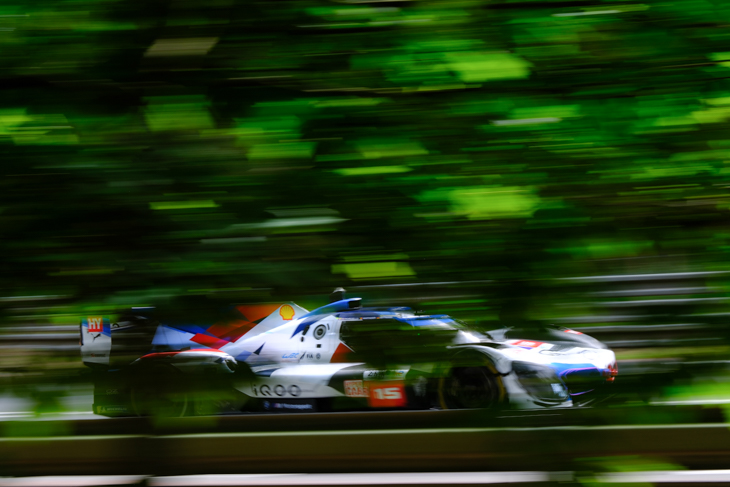
“To be honest (updating the car) is not on the radar,” he explained. “We are looking at areas we can improve. I am of the opinion that we entered a BoP championship, so as long as you can adapt the cars in the BoP window to be equal in terms of lap time performance, it should be done that way. If you struggle in certain areas, that cannot be adjusted by BoP, then it’s correct to use a Joker, but we are not there yet.
“We are still understanding the car and developing it in the areas that homologation allows. When we reach a point where we realise an area we need to improve we will investigate what we can do. You generate a list of course with points we where you could do better. But is it valid as a Joker yes or no? We are not there yet. Nothing is planned at the moment.
“In the first three races, we’ve had two LMDh cars win, and the field is close between LMDh and LMH. It’s a quite level playing field and we have to look not only at pure lap time figures but also at how cars use tyres, these are things that you need to check.
“I have to say this year we can’t complain generally, we see good competition between the manufacturers.”
Going forward, beyond updates, it appears that customer M Hybrid V8s are unlikely to be introduced either.
BMW is exploring the idea and acknowledges that there is demand. But is not yet convinced that it makes business or sporting sense to supply cars to private teams like it does in GT3 and GT4 competition.
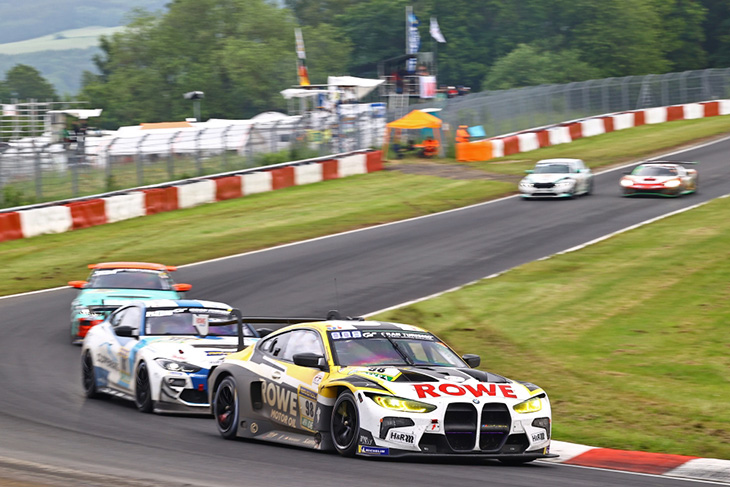
“With new manufacturers bringing two cars in the future it will be difficult to have grid space,” Roos said. “We have requests from potential teams and customers. But our approach is a bit like what we do on the GT3 side.
“We limit ourselves to the amount of cars we want to have because we clearly want to have quality cars. It’s not only where the cars are running, but how you support them. If you want to do it you want to be competitive with happy customers. This is very important. If you bring multiple cars and they are not supported and the cars are too complex, it needs a lot of effort.
“We are focused on our (factory) cars now, and to make everything in the window where we need to be. We will have internal discussions about possible customer cars next year and take a decision from there. I don’t want to say yes, or no. It’s something we will look at next year, but we want quality, not just quantity.
“And it’s clear to me on the commercial side that it (customer cars) will not help to finance the general operation. We have found a formula that works, because if it didn’t you wouldn’t see nine manufacturers.
“We made the right steps in bringing the cost down, but there’s a lot of money involved and one, two or three customer cars will not help you to fund it. The costs are so high that I wouldn’t feel comfortable telling a customer that they are financing our factory cars.
“It’s not about the money, you just want a competitive car on the grid, that is the first goal. Of course, you need to talk about money, but the first goal is how you want to run the programme.”
Nevertheless, Roos reiterated that BMW is fully bought into competing in the WEC and, like other major manufacturer bosses, was keen to comment on the success of the ruleset and the championship’s growth.

“We are definitely satisfied (with life in the WEC),” he said. “The championship has taken a step from 2023 to 2024 with record crowds at Imola and Spa. And there were so many people going to Le Mans Test Day. Le Mans is obviously key too and it’s a sell out with more than 300,000 tickets sold months in advance for what is one of the greatest and most important races worldwide.
“For us, this is definitely not a one-year thing. We want to do more here and it’s something we are committed to so we can showcase what we do and our technology.
“And this ruleset came at the right time, with cars like the BMW M5 which is a V8 hybrid, like what we run in the WEC. That road relevance is important. The GT3 car is close to the road car, you use the road car to develop the race car, but on the LMDh side we develop technology and we can showcase it.
“This platform gives us everything we need at the moment.”