
It did not seem quite right. There were no Porsches in the prototype class, no Ferraris, Jaguars, nor other marques which had made their names in the Le Mans 24-hours. The entry list for the 2000 race looked decidedly lacking in charisma.
The frisson of the previous year, with three manufacturers fighting for the lead, seemed to have faded. Mercedes-Benz, Toyota, Ferrari and Nissan had all disappeared within the space of one season, while BMW, which, like Toyota, had gone to play in Formula 1, was only represented by an old, privately entered car.
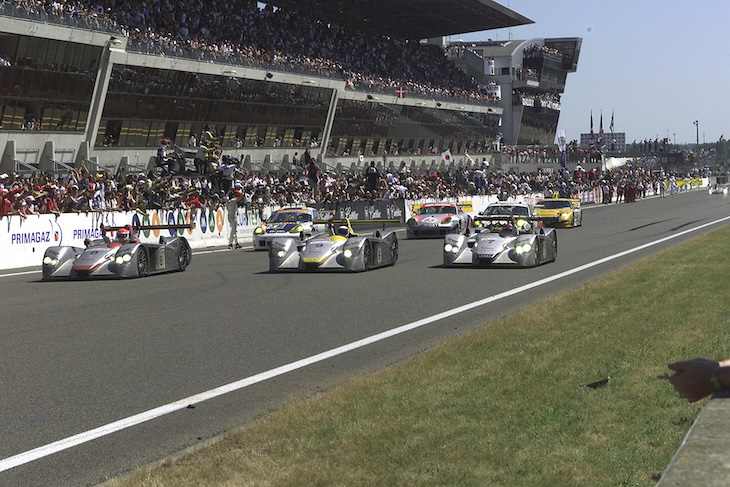
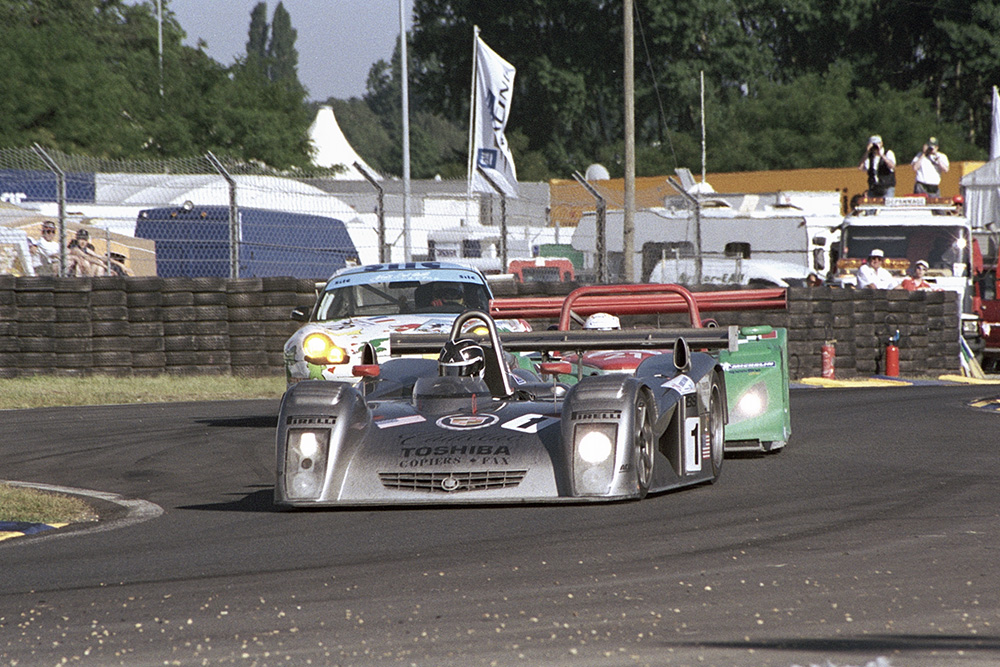
As far as manufacturer-entered cars went, there were only the untried Cadillacs and a trio of Audis… and those three German cars were easily the favourites to win.
Audi? Admittedly, Audi did have a leading motor sport presence, but that was in rallying and touring car racing. Back then, it did not even have a sports car in its road car line-up. Now it was favourite to win the world’s greatest sportscar race.
Audi had dipped a proverbial toe into the waters of La Sarthe the previous year, hedging its bets. Two Dallara-built roadsters, the R8Rs, had been run by serial Le Mans winner Reinhold Jost, while a pair of totally different closed cars, the R8Cs, had been built by the UK-based, Volkswagen Group-owned RTN, these having been run by another former Porsche entrant, Richard Lloyd.
The open-topped cars had performed well for newcomers, finishing third and fourth, although one had suffered from gearbox maladies. The aerodynamically unstable coupés fared far worse, both retiring, one with a broken differential, the other also succumbing to gearbox troubles.
Although never really in contention for the win, Audi had shown it was taking Le Mans seriously. The R8Cs were retired, while Audi, with Dallara, went about developing the roadster into what would become a Le Mans legend.

The lack of a serious opposition a quarter of a century ago should not really detract from what Audi achieved. It’s R8, as the new car was known, was a very different, focused beast from the 1999 roadster, although it did share its 3.6-litre turbocharged V8 engine. Even that had been lightened and major gains were made in torque output, fuel efficiency and driveability.
Every effort had also been made to lower the car’s centre of gravity, concentrate the mass within the wheelbase and reduce frontal area. Project leader Wolfgang Appel had produced a car that was not only faster but also, and this would prove important, maintenance friendly.
“By the time (the Audi engineers) had got to the R8, they had learnt a lot. It was massively better,” recalled designer Tony Southgate, who had been involved with the 1999 cars. “It was unbelievable. It was probably the biggest step forward that a manufacturer has made in motorsport.”
Audi’s engine designer Ulrich Baretsky concurred: “The 1999 car was old-fashioned, but we had no comparison with the past. However, in 2000, we made a big, big step, and the car is a legend now. Every driver is still dreaming of it.”
A pair of R8s had been taken to Florida in the March to compete in the 12 Hours of Sebring. They dominated practice and qualifying, taking the airfield circuit’s notorious bumps in their stride. Although no longer interested in La Sarthe, BMW was still running a works team in the American Le Mans Series and one of these remained within striking distance until the final hour.
However, there was little doubt as to who would take the first two places with Frank Biela, Tom Kristensen and Emanuele Pirro coming out on top after a battle with their teammates. Over the winter, Audi had progressed from a Le Mans new boy to the position of outright favourite to win the 24-hours.
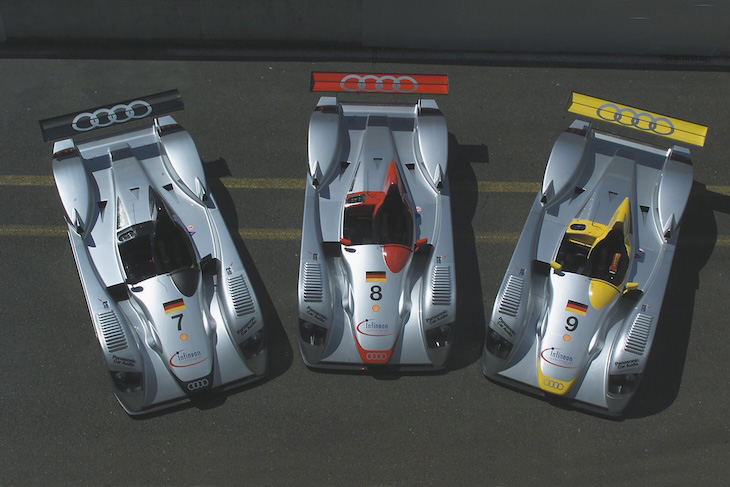
That June, despite the heroic efforts of Panoz number one driver David Brabham, there would be no doubt. The front runners in 2000 were grouped in a new LMP900 class. 21 were entered, although it seemed that only three mattered – the silver projectiles of Biela/Kristensen/Piro, (R8-404), Laurent Aïello/Allan McNish/Stéphane Ortelli (R8-405) and Christian Abt/Michele Alboreto/Rinaldo Capello (R8-402).
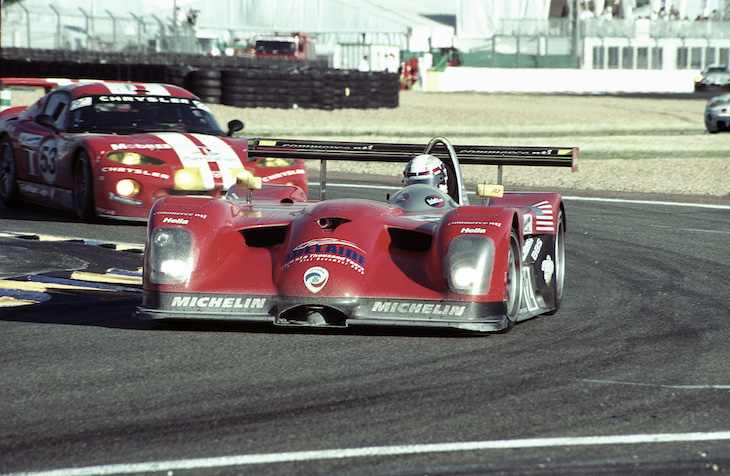
Mention also has to be made of the front-engined, Ford V8-powered Panoz LMP1s. Two cars were entered by the factory, backed up by a trio of private entries. Apart from one of these, no one else would even come into the story.
It is easy to be right with hindsight, but it seemed to be a case of not whether an Audi would win, but which one. April’s test day underlined this feeling. Their nearest competitor at the time, Team Rafanelli’s Lola, was two seconds slower despite, as McNish recalled, “the front aero was a bit sensitive.”
Having said that, during private testing, there had been problems, and reliability was not a given. Indeed, during qualifying, a piston broke in R8-402’s engine. It was never discovered why, but it would not happen again. Audi R8 engines would prove to be remarkably reliable, some of them clocking up in excess of 10,000km.
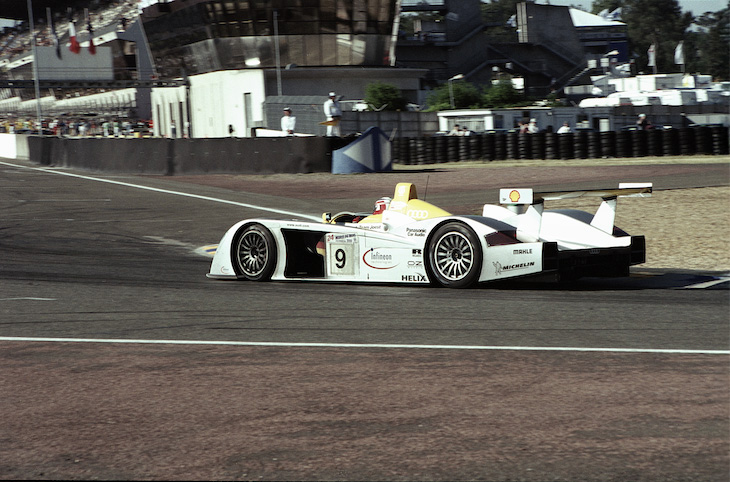
It was no surprise when the R8s secured the front three places on the grid, almost six seconds faster than the quickest Panoz. A determined McNish set the fastest time in the yellow-nosed R8-405. “It was not the best lap I have done at Le Mans,’ he recalled, “but it was neat and tidy.”
The race itself began in searing heat with the Scot scorching ahead. Even at this early stage, only Brabham’s Panoz was anywhere near in sight of the German cars. There was now undoubted proof of the R8s’ pre-eminence. However, less than an hour into the race, one of the Cadillacs caught fire and out came the safety car.
The Panoz works team manager, David Price, made use of this to produce a false picture by calling Brabham into the pits early, thus putting him in the lead when racing resumed. A front-engined car had not led at Le Mans since 1963. Brabham relished the situation for a while, but it could not last. He admits that, as he and McNish sped down the Mulsanne straight, “I stuck my hand out and gave him the bird!”
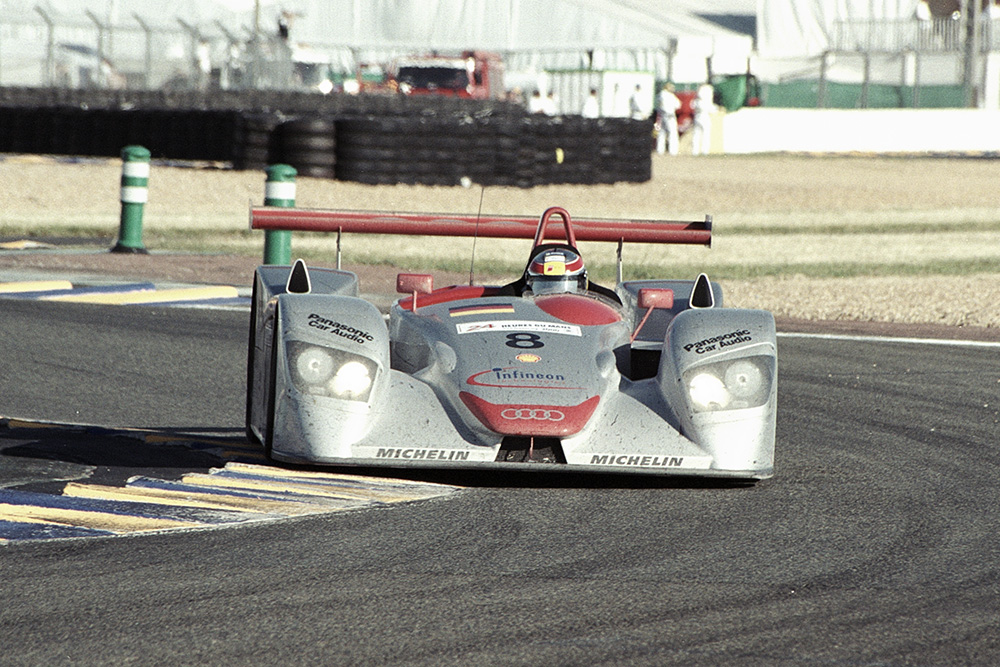
Back in the lead, McNish now found that he had a teammate, five-time Grand Prix winner, Alboreto, on his heels. “I was giving it hell and Michele was just sitting there behind me.” Traffic then enabled him to pull out a bit of a gap, but with the third round of pit stops, the Italian stayed in the car, while the Scot handed over to Ortelli, losing the lead in the process. Then, with the next stop, the positions were again reversed.
What of the third Audi? Could this have been the tortoise in the team? (spoiler alert, we all know what the tortoise achieved.) Seemingly unable to keep up with his teammates, Biela had been running in fourth behind Brabham. However, a rapid pit stop in the third hour enabled Kristensen, now in the red-nosed car, to move ahead of the Panoz. The Audis now occupied the first three places. By 11:00pm their nearest rival was a complete lap back. The story of the rest of the race, as far as overall victory was concerned, revolved around the varying fates of the three German cars.
With a quarter of the race over, “everybody in the team,” according to McNish, “felt reasonably comfortable.” Now, though, was to come a pit stop that was to pass into Le Mans legend but which was, arguably, to cost him victory.
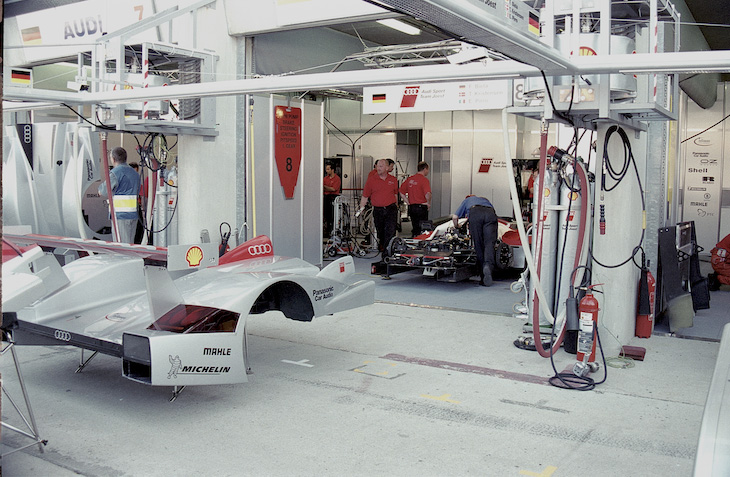
Joest’s technical director and team manager, Ralph Jüttner, recalled that there was a worry over the gearboxes, which lent to the R8S featuring a modular design. “We invented the rear-end change because the biggest fear that we had was the gearbox. We made sure that we could change the rear end in a very quick time.”
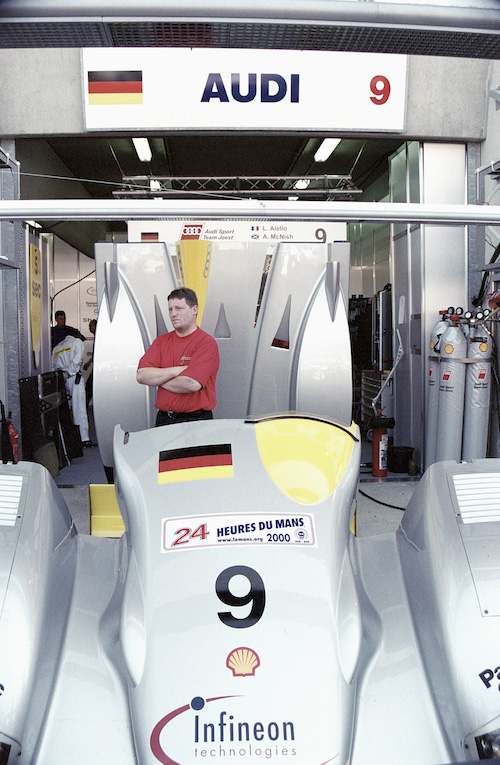
However, it was concern over the spherical bearings that were pressed in the wishbones that was to bring about the legendary pit stop. Knowing this issue, Chris Horvath, chief mechanic for R8-405 checked them with a torch at each stop. Jüttner recalled: “We gave him full authority to make any decision about them and, late at night, he gave the call and the car was wheeled into the garage.
“Thus, the rear end was changed because he had seen the bearings coming out, not because of any problem with the gearbox. It was the right call but lost the car the greater part of a lap.”
Aïello had brought the car in at 10.55 pm, and McNish left the pits with it at 11.02 pm. It was a remarkable example of Joest’s teamwork.
Indeed, this amazingly rapid rear-end change is said to have led to Audi dealers having to explain to their customers why the gearboxes of their road cars could not be replaced as quickly.
McNish was, though, now nearly two laps adrift of the leader. At the end of the race, he was just a lap behind the winner. The calculation is obvious, but such is endurance racing.
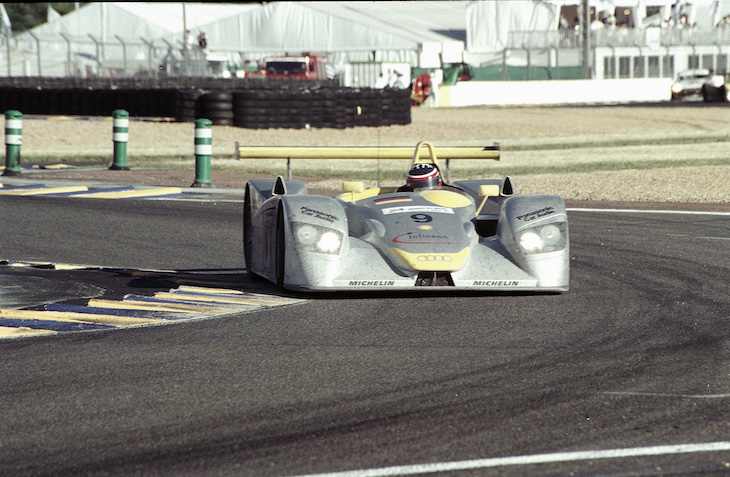
Up front, Pirro was closing the gap on Alboreto. The pace of the ‘tortoise’ was now starting to look ominous. Not long before midnight, the leader suffered its second puncture of the race and dropped back. R8-404 was now up front. Also having (admittedly minor) problems was R8-405.
The black nosed R8-402 then had another puncture, which caused suspension damage. This meant replacing the complete rear end with another of those amazingly fast changes. There is a certain irony that the original raison d’être for the ‘quick-change’ rear end was a concern over the Ricardo gearbox, and yet the R8s did not suffer any gearbox problems during the race.
The three Audis now proceeded on towards the end of the race, but Allan McNish was determined that it was not just going to be a procession. “We all know Allan, of course, he was pressing on,” remembered Jüttner. During a quadruple stint, he set the fastest lap of the race. “This was just me pushing like mad,” said Allan. “It was the statement that we are not giving up. These things are important for the mechanics, as for everyone else. They have worked through the night, and they have the same passion invested. We might have lost the war, but we won this particular battle.”
After 16 hours, a brake change was carried out for the first-placed Audi. McNish came charging back onto the lead lap, but with two minutes still to be made up, it looked as if he had insufficient time left. At this stage, there was no suggestion of a formation finish, but a reduced pace was dictated to the team. Only at the final pitstop did McNish realise a second victory at Le Mans was now within his grasp.
Jüttner was not happy about the thought of a formation finish but Audi board members were keen on the idea with all of its marketing promise. Reluctantly, the Joest team ordered McNish to fall back behind the leader and put himself a lap in arrears.
There was no way that Ralph was going to slow Pirro down. Looming over him was the finish of the 1966 race when Ken Miles had been delayed by Ford in order for Bruce McLaren to catch him up, only for the New Zealander to slip past in the closing seconds.
Would McNish have been tempted to do the same? When asked, he grins and replies, “there is no question I would have done, but I think they knew the animal they were playing with.” Accordingly, Biela, Kristensen and Pirro took the victory for Audi.
Eager to get back to the UK as soon as possible, a disappointed McNish left that night with GT driver Johnny Mowlem. The latter did all the driving but insisted that Allan talked all the way to keep him awake. Many years later, he recalled how the Scot had fallen asleep in mid-sentence. As was said at the time, it was a good job he did not do so down the Mulsanne straight.

25 years ago, a new era commenced at Le Mans. Audi, the new boys, put their stamp on the 24-hour race, making themselves worthy to be listed alongside the great names of the race. Perhaps the opposition was not always the strongest, but 13 wins since then is no mean feat. Only Porsche has scored more.
Of those victories, five were won by R8s. A new FSI direct fuel injection engine was introduced for 2001, but the winners were the same trio of Biela, Kristensen and Pirro. A year later, the three achieved the hat-trick.
In 2003, the Audis had to give way to their Volkswagen Group stablemates, the Bentleys, although it should be pointed out that these were Audi-powered. In 2004 and 2005, the R8s were back at the top of the podium despite the fact that in their final year at Le Mans, they were hobbled by new restrictions. During these years, the Audi R8s were also the leading front runners in the American Le Mans Series and its European equivalent.
The thought of a one-horse race likely to be dominated by a team with no sportscar racing pedigree 25 years ago may not have set the pulses racing at the time, but it changed the face of Le Mans.
And, mainly thanks to Allan McNish, it was not a bad race either…