As part of our preview to the 2025 event, DSC historian David Greenhalgh outlines some unusual aspects of Le Mans history.
1. Five types of grid
Five different ways of deciding the grid have been utilised in the 62 years since qualifying times were first used to determine grid positions.
The first experiment came in 1980, when pole was decided by the average speed of the drivers in a car: Henri Pescarolo/Jean Ragnotti (Rondeau) came out on top. Curiously, some records of the ACO simply ignore this inconvenient fact, and attribute “pole” to fastest qualifier John Fitzpatrick (Porsche 935). This explains why it was said in some quarters that the 2024 pole position was Porsche’s 19th, not 18th, in the history of the race.

The second innovation was adopted for the heavily-political 1991 race, when the first ten spots on the grid were reserved for Category 1 cars. This saw Philippe Alliot claim pole position with a time 3.8s slower than Jean-Louis Schlesser, who was 11th on the grid.
Then in 1996 and 1997, the decision was made to give the prototypes grid positions 1, 3, 5 etc while the GT cars had 2, 4, 6 etc. So in 1996 Pierluigi Martini edged out Jerome Policand for pole position by just 0.11s – but Policand’s Courage had to line up 3rd on the grid, behind a GT car which was slower in qualifying.
Finally, from 2020, the cars were grouped by speed in separate categories.
Otherwise, the conventional manner of deciding the grid has been utilised.
2. Old and gold
In 2024, Sebastien Bourdais, 45, fell just 0.182s short of becoming the oldest man to win pole position for the race. That honour still rests with Bob Wollek, who was 43 in 1987 when he claimed his third and last pole position.
3. Not for the young
Pedro Rodriguez was 23 when he claimed the first pole position determined by qualifying times, in 1963. Given the trends to youth in the sport in recent decades, it is surprising that the Mexican is still the youngest driver to win pole position for the race.

It is even more surprising that only nine drivers in their 20s have ever claimed pole position at Le Mans. The typical pole winner at Le Mans is in his mid-30s, like Kevin Estre, who was 35 when he pulled off his last-gasp pole lap in 2024.
4. Better over the distance
The other irony of Rodriguez’ youngest pole record is that, as a stereotype, it is easy to imagine young drivers throwing caution to the wind in qualifying (think of 24 year old Mark Blundell’s heroic pole lap in 1990), but harder to envisage pacing themselves properly over the 24 hours. So at first glance it seems incongruous that three drivers – Alexander Wurz, Luis Fontés and Chris Amon – have won the race when they were only 22 i.e. younger than Pedro Rodriguez was when he took pole.
5. David and Goliath
William David is not exactly a household name in the illustrious history of the 24 Hours. But he holds the distinction of being the only driver to take pole position in his debut in the race, which occurred in 1995. For this record to be equalled, a driver would need three stars to align.

Firstly, he would need to make his Le Mans debut in a car capable of taking pole. This is not especially uncommon; for instance, this year sees Pascal Wehrlein (above) making his Le Mans debut in no less than a works Porsche 963. Secondly (getting harder), the debutant’s team manager needs to choose him to be the qualifying driver, ahead of his two more experienced team-mates. Thirdly (harder still), if he gets over those two hurdles, there is the minor matter of actually producing a lap time good enough for pole.
It is therefore very unlikely that anyone will match David’s feat any time soon – if ever.
6. Six and out
There is another Le Mans qualifying record which looks even more immune from attack than William David’s pole position on debut: the greatest margin by which pole position has been achieved.
In 1976, Jean-Pierre Jabouille (Alpine A442) went to the start with the useful advantage of 6.7 sec over second man on the grid, Jacky Ickx (Porsche 936). Indeed, Jabouille’s pole time was so daunting that nobody else made a serious attempt to reach it.
The Alpine ran into a series of mechanical problems in the race, so all that speed counted for nought when it mattered, but nevertheless it is difficult to foresee how the extent of Jabouille’s qualifying supremacy could ever be bettered in future years.
7. Tight at the top
At the other end of the spectrum, and more relevant given the current intensity of competition, is the narrowest margin by which pole position has been claimed.
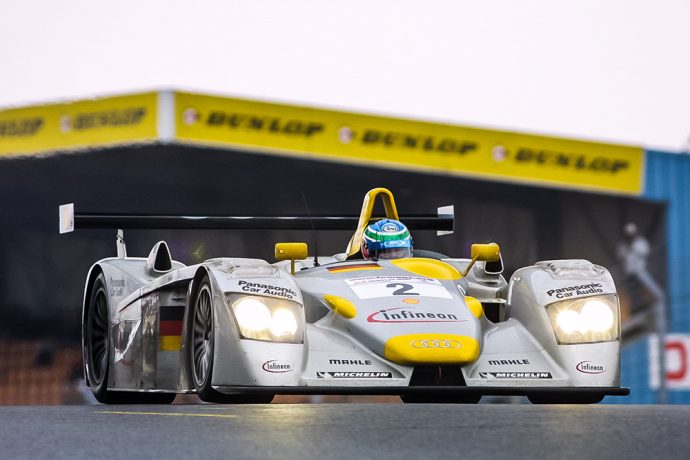
That occurred in 2001, when Rinaldo Capello (Audi R8) shaded his Ingolstadt colleague and rival Tom Kristensen by 0.029s, an infinitesimal margin over such a long lap. This was one of three occasions, the others being 1987 and 2011, when pole position for the 24 Hours was claimed by less than a tenth of a second.
8. Win from the front
Qualifying times were first used to determine the grid in 1963, so that system has been in force for 62 of the races. During that period, more outright winners (13) have started from pole position than from any other grid spot, while 12 of the winning crews started from second on the grid.
This means that a remarkable 40 percent of the races have been won from the first two spots on the grid. As reliability of the cars has improved, the trend has become even more pronounced: 14 of the 25 races this century have been won from first or second on the grid. It is traditional to assert that qualifying is irrelevant for such a long race – but history suggests otherwise.
9. Win from the back
The crew which has won the race from the deepest recesses of the grid did so for an unusual reason. As noted above, the political situation ensured that the top ten spots on the 1991 grid should be reserved for the new 3.5-litre cars. The Herbert/Gachot/Weidler Mazda 787B was the 12th fastest qualifier, but started 19th on the grid.

A more conventional win from the back came in 1970. Richard Attwood/Hans Herrmann gradually worked their Porsche 917K from 15th on the grid to the lead, in a race of heavy attrition in appalling weather.
10. Six in a row
The record for the most consecutive pole position lies with Toyota, who claimed the top spot for the six years between 2017 and 2022.
Group C enthusiasts may wonder why Porsche doesn’t hold this record. However, when the works 956s boycotted the 1984 race, the private Porsches couldn’t even get close to the speed of the Lancias, who comfortably secured the front row of that year’s grid.