

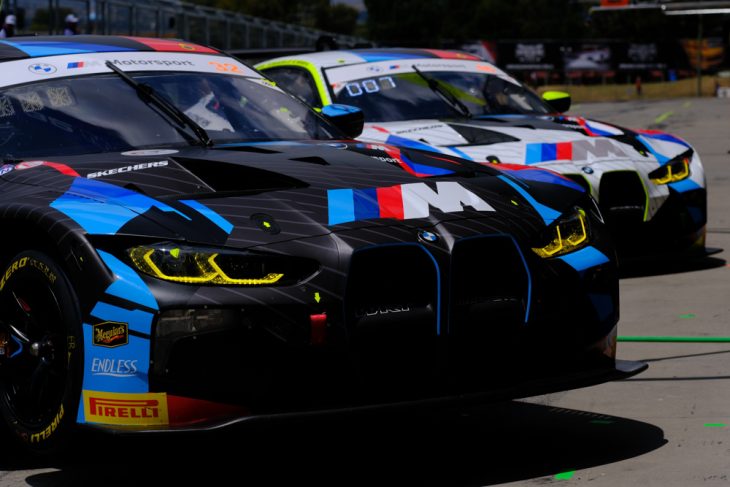
The Intercontinental GT Challenge is back in the spotlight this month, with back-to-back 24-hour races at the Nürburgring and Spa-Francorchamps acting as rounds two and three of the five-race calendar in 2025.
Just getting to the track in one piece, with all the necessary equipment and staff for each of the IGTC events, requires a colossal amount of planning from the teams competing, and it begins months before the first trucks (or containers) arrive in the paddock.
With such a huge gap between the first and second events on the schedule, it’s easy to forget that the 2025 IGTC campaign began way back in late January, early February at Bathurst. That, though, is a big part of the IGTC’s appeal; it’s a series that cherry picks big events from a variety of racing cultures worldwide across the racing calendar.
And for a team like WRT, which is in Spa for its home race this week, but also took part in (and won) the IGTC curtain raiser 16,500 kilometres away four months ago, the lengths it has gone to as an organisation to fight on both fronts this year shouldn’t be overlooked. It’s even more impressive when you consider that the team also has the not-so-small matter of a four-car FIA WEC programme with BMW to manage on top of its SRO programmes.
Commitment to the cause
It’s no secret that when the entry for the Bathurst 12 Hour this year was finalised, there was widespread commentary on the lower-than-desired entry count. 22 cars – only 18 of which were GT3 – were on the grid, which was the lowest entry count for the Bathurst 12 Hour since the 2022 event, which was the first since the pandemic.
Of those, six cars came to Australia from overseas-based teams: three Mercedes AMGs from Craft Bamboo, Team GMR, and SunEnergy1, a Porsche from Absolute Racing, and two BMWs with WRT.

Despite the lower car count, the race was as spectacular as ever, with battles all the way through the field culminating in a fuel-saving run for WRT, securing a 1-2 finish for BMW’s first win at the mountain.
By comparison, the 2020 race, held only weeks before the global shutdown, featured 17 cars shipped in from overseas, including Porsches, Mercedes, McLarens, Nissans, Acuras, Lamborghinis, BMWs, Aston Martins, Ferraris, and the race-winning Bentleys. On that occasion, the Pro-GT3 class consisted of 20 cars.
With that in mind, what exactly does it take for an internationally based GT3 team to get to the grid for the Bathurst 12 Hour? How early do decisions have to be made, personnel sourced, and containers sent, and how has that changed in the years since the pandemic?
“It’s always after summer, we have kind of an idea, but no commitment,” Team WRT boss Vincent Vosse told DSC when asked about the process of putting a two-car entry together. “We know that there is a good chance that we might do Bathurst [by then].
“Commitment, I think that’s around November.”
So for WRT, it’s a short 2-3 months between committing to an entry and being on the grid ‘Down Under’. But, Vosse is assured that this was normal for WRT and just part of its wider operations.
“It is not the only international race that we are doing – I think one of the cars went to Bathurst from Indianapolis [the IGTC Indianapolis 8 Hour in October], and the second car… Probably from Jeddah [the GTWC Europe 6 Hours of Jeddah, at the end of November], or from Indianapolis also.
“Then we have containers, and kit, we call them ‘Kit 1’, ‘Kit 2’, ‘Kit 3’ [etc], running around the world.
“And the personnel? I think we have a normal GT World Challenge crew of 25 [people]. We have what it takes to adjust this. We are flexible enough to adjust this.
“If we were not doing all those races, and not so used to managing those containers, it would probably be more difficult to be flexible.
“We know from, say, late summer that there is a good chance that we will do [Bathurst]. From there, we give some deadlines to our partners, maybe one of the deadlines is to send a container.
“Of course, there is some risk, but it’s part of the game.”
A global operation
The kit used in Bathurst, much like an F1 operation, isn’t the only equipment in motion around the world for Team WRT. But the logistical puzzle extends to its cars as well.
The Bathurst 12 Hour was the third race for the Belgian outfit in 2025, after back-to-back victories at the Dubai 24 Hours and the Yas Marina 6 Hours in January. Then, within the month of February, Team WRT headed to the WEC prologue in Qatar with two BMW M4 GT3s as well.
“That’s all different cars, those two cars [at Bathurst] are owned by BMW. The two races at Dubai and Abu Dhabi are two other cars,” Vosse explained. “And the two cars which are running in Qatar, in a month’s time [for the WEC Prologue and Qatar 1812] are different cars.

“The two cars for the WEC, due to the torque sensors and the massive electronics that they have on board, are only doing the WEC. And the material [kits] are the same, the material that we use in the WEC is only for the WEC.”
However, even with the flexibility, sets of materials, cars, and personnel that WRT has on hand, it’s still a challenge to ensure everything is where it needs to be, when it needs to be. Vosse explained that even with the multiple sets of gear, the increasing calendar congestion in GT3 makes it a tight turnaround.
“[Bathurst] is an event that you cannot be further [from home],” Vosse said. “The cars are going back [to Europe] by air.
“Sometimes you can organise for cost, and ecological reasons, to freight by boat, but sometimes, these two cars are normally cars that are doing the GT World Challenge Europe. We’re testing in about three weeks.
“And, here [at Bathurst], we’re driving with the 2024-spec car, not the Evo car. We have a bit of work on each car to make it the Evo kit.
“Everything is quite tight.”
It is an incredible feat to have the cars back on the other side of the world, upgraded, and on track mere weeks after racing at Bathurst. Vosse was quick to add that Team WRT had to learn how to manage the challenges of racing at Bathurst, as part of learning the challenges of flyaway racing in general.
“Luckily, we are quite a stable team, with the same people around for the last 10 years,” Vosse said.
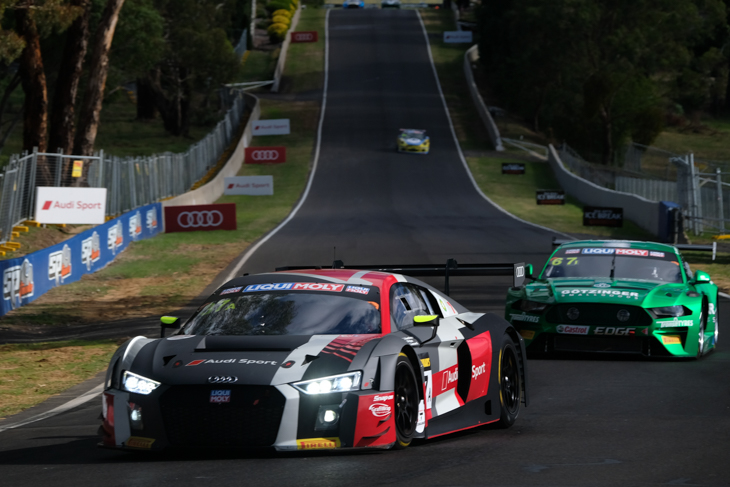
“When we came here in 2018, it was a challenge. You have to come here for the first time to know, what doesn’t go right, what you need extra, what you should have done in a different way.
“When we came here [in 2018], we were helped by Team Walkinshaw. One of our sporting directors, Pierre Dieudonné, who won the [Bathurst 1000] back in the 80’s (Note: Dieudonné and Steve Soper’s Ford Sierra crossed the line to win the 1987 Bathurst 1000, but was later disqualified for modifications made to the car). He’s a very close friend of the Walkinshaw family, so we asked them for support.
“When you are far away from home, and you need something, it is always helpful to have local people.
“Now we have a bit more experience, we are used to travelling. Okay, it’s Australia, but [it’s not that different] when we are in Fuji, Indianapolis or Laguna Seca, or wherever we are. When you are missing something, it’s not something you can bring the next day!”
Making the sums work
Bathurst is undoubtedly ‘a special place,’ but there’s still a significant financial aspect to consider before committing to the IGTC’s visit to New South Wales.
For Vosse and Team WRT, the backing of BMW makes it a much more achievable prospect.
“It’s very difficult to come to such a race without having a manufacturer behind [you],” Vosse explains. “We would love to be here every year, but the financial aspect is very important.
“In the end, it’s maybe not me that’s deciding if we are coming, but more BMW saying ‘it’s on the cards, and it’s important to us’.
“They can do some activation with the local market. [Thursday prior to the race] was the launch of the new M3 Touring CS, so there is some activation.
“We won the race here in 2018 as a private entry, but it’s much nicer to come here with a full factory line-up!
“The cost of travelling and logistics has gone up in the last four years or so, but it is an event which is important enough that there is the interest to run factory cars.”
With all of that said, how much does it cost to get a two-car GT3 team from Europe to compete in the Pro-Class of the Bathurst 12 Hour?

Vosse doesn’t put an exact number on it, but quoted a ballpark figure in the mid-to-high six-figure EUR range.
“It’s very tricky, because it all depends on how you are doing it,” Vosse elaborated. “For us, the car and the parts are owned by BMW, so it’s different. In a factory entry, you don’t have all the costs because there are things that you are not counting.
“If you run a private entry, you know the exact cost.
“If you have a chance, not to air-freight, that has a huge impact. But that’s getting difficult because it’s also getting close to the start of the season in Europe.”
But, the allure is the challenge of ‘The Mountain’.
“We are a professional team, but also a passionate team. We always want to be in Bathurst,” Vosse said. “There is not a racing driver who doesn’t know what Bathurst is. There’s no driver who would not say ‘I would love to drive Bathurst’.
“Bathurst is in the top five of the all-GT races you want to win.”
And with the 2025 result, Team WRT can say it has won that too.
With all the challenges, from freight, cars, spares, personnel, calendar congestion, and the sheer distance that Australia is from most other parts of the world, it is remarkable that any team can make it across to the grid for Australia’s International Enduro.
And here we are, in June, ahead of the biggest GT3 race in the world at Spa-Francorchamps, where the 2026 IGTC calendar is expected to be revealed. Once those dates are locked in and WRT departs the paddock on Sunday night, it won’t be long before the planning starts for its next IGTC adventure…
Images courtesy of Andrew Hall


