With the 2025 FIA WEC season entering its final stretch, the Alpine Endurance Team is looking to end its slump in form since the #36 crew captured two consecutive podium finishes earlier in the season at Imola and Spa.
It’s been a yo-yo campaign for the French manufacturer and its A424 Hypercars, which have at times shown blistering pace but more often than not failed to fight at the front. The season opener in Qatar saw both cars finish outside the top 10. At Le Mans, on home soil, only a handful of points were scored across both cars. And in São Paulo, the team’s best-placed car was ninth.
So, where should we set expectations for the team going forward, as it looks to fight for silverware consistently?
The French team firmly believes that the best is yet to come from this programme. And the signs that this is the case are readily apparent.
The A424 has made significant strides in reliability this year. After the disastrous double DNF at Le Mans in 2024, both cars made it home this time around. It was far from a standout performance back in June, with the #35 finishing ninth, leading home the sister car in 10th, multiple laps down, but it was a clear marker of progress.
Speaking to DSC before the race, Alpine wasn’t expecting to fight for a podium or the win, in part because the pace wasn’t there (Balance of Performance, of course, was a factor), but also because the primary objective was to showcase the car’s newfound durability above all else. Following the team’s EVO Joker update for 2025, which focused on enhancing the A424’s Mecachrome-based turbocharged V6 engine, getting both cars home was a must.
“We have to be pleased on one side,” reflects Philippe Sinault, Alpine Endurance Team’s team principal, “it was a step, a new step.”
The charismatic Frenchman is under no illusions that a better result was left on the table by his team, though.
“To be honest, we ran the type of race we needed to run last year,” he admits. “We did the minimum, and we made so many mistakes. Without mistakes, we wouldn’t have finished in the top three, but we could have achieved something like P6, P7.”

Since Le Mans (as reported by DSC earlier in the season), Alpine has also moved the A424’s engine programme entirely in-house to the brand’s engineering centre in Viry, France. This change, which Sinault confirmed was possible due to the resources freed by the Alpine F1 team’s switch to Mercedes power for 2026, is expected to increase the efficiency and effectiveness of the manufacturer’s work behind the scenes to improve the car.
“Alpine decided to shift the partnership with Mecachrome (which remains an important supplier) because they have all the facilities internally, the talent and the knowledge of how to manage engine subjects, as they were and still are involved in Formula One,” he says.
“It’s a great move because we are close with Viry, and this high-priority topic is in-house now. It’s the right move to improve. We are fully confident that this is good news for us.”
What it doesn’t mean is that a new engine or a significantly revised powerplant is on the way. Sinault says that Alpine will retain the base engine and focus primarily on gains in software, an area of the rulebook which is wide open for teams to work on.
It’s not just about the engine, it’s how we handle and manage the engine
“The subject of software is so complex,” Sinault adds. “It’s not just about the engine, it’s how we handle and manage the engine, for example, through traction control. All the aspects around the engine impact the balance of the car. If you have good traction control, you are more efficient out of corners, and that can give you big gains from the engine you already have.”
So, what will the next EVO Joker focus on? Alpine is in the process of whittling down its options. Manufacturers must be strategic with Joker usage, as they are limited to a set number by regulation; therefore, Alpine, understandably, isn’t rushing into a decision.
However, changes to the car’s aero package would likely prove to be most effective and valuable. Sinault says the FIA and ACO’s move before Le Mans last year to the two-stage BoP process, which manages power levels above and below 250 kph, has had a significant impact on the team’s ability to exploit the A424’s greatest strength: straight-line speed.
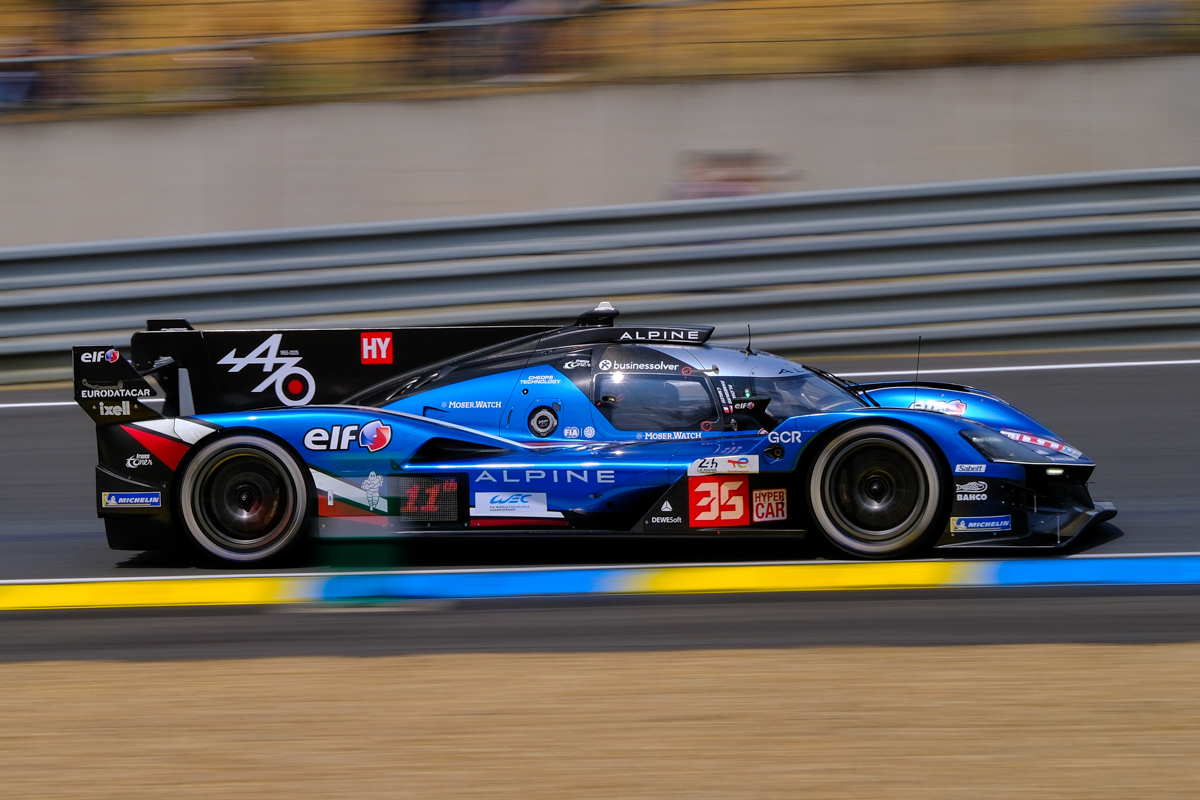
If it is to break through and become a regular contender for wins and, eventually, championships, the team knows it has to make the car more effective across a variety of circuit types.
“At the moment, we are missing some details to be at the right level, and we’ve made many small mistakes,” Sinault explains. “The philosophy of the regulations changed a little bit with the top speed, and we could not adapt well. The car is homologated with one philosophy, and now the posts have been moved; it does not really help.
“The main target of the organisers is to have all the cars in the same window. It’s not an easy game; it’s tough. We homologated the car with our philosophy, focused on Le Mans (and the Circuit de la Sarthe’s long straights). And, to achieve convergence, they changed that a little bit.
“My main concern is this. For us, (with the new rules) it’s really different now compared with the initial choice we made about the homologation of our car. In the end, it’s been double pain. They tried to help us bring more downforce, but we are not able to use it, because our car was not created and designed for this.
We are waiting for the ACO and FIA to present a strong view about the philosophy, so we can build our car and set our car in the right way
“The ambition of the rules is really high, though. We can’t cry or say it’s a scandal. It’s ok. But we are really open now to making improvements and changes to the car in the future. We are considering it strongly.
“It’s difficult to say which direction we will take. Nothing is decided yet, because we have so many areas to improve. We are waiting for the ACO and FIA to present a strong view about the philosophy (on BoP going forward), so we can build our car and set our car in the right way.”
Looking further ahead, and beyond the potential for another major revamp in the way that the performance levels in Hypercar are managed, Alpine, like Porsche, is not against a shift to a single platform.
To improve the level of parity across the field, a movement is gaining momentum that would see the ruleset become more streamlined by the end of the current decade. This is a topic that the rulemakers are set to discuss in detail with all the OEMs involved over the coming months and years, following the recent announcement at Le Mans that the Hypercar ruleset will be extended to the end of 2032.
Could it mean a shift to LMH only, LMDh only, or LMDh with more freedom concerning the chassis spines (to give LMH factories more options to design their own car)? What about a new platform that blends both current sets of technical regulations? If changes are indeed coming, a compromise will have to be reached between the suite of manufacturers in play, who all bring an individual set of priorities to the table.
“What is certain is that a simpler, fairer ruleset for everybody would make life easier for the rulemakers,” Sinault believes.