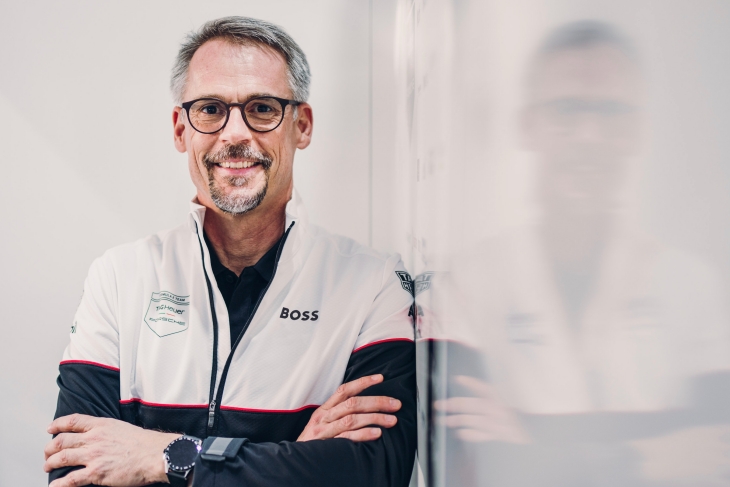
Porsche Motorsport’s vice president Thomas Laudenbach feels that the current crop of Hypercar and GTP manufacturers need to come together now to begin planning for the next set of top class sportscar regulations.
Speaking with the media ahead of the opening race of the 2025 FIA WEC season in Qatar, he made Porsche’s stance clear. He feels a set of rules based on a single platform would be the most sensible way forward and that the manufacturers should collaborate on a framework for the FIA and ACO to work with soon.
As it stands the current Hypercar ruleset is in place through to the end of the 2029 season, following a two-year extension announced at Le Mans last year. This is a decision that has been widely welcomed by the manufacturers already in competition and prompted additional OEMs (Genesis and Ford) to commit to programmes from 2026 and 2027 (respectively) onwards.
Behind the scenes, work is ongoing to paint a picture of what’s to come through the start of the next decade, but little has been said on the record about the future of LMH and LMDh specifically. Instead, the ACO and FIA, have been more vocal about their work with select manufacturers on a ruleset that would see hydrogen-powered prototypes compete at Le Mans and the FIA WEC from 2028 (following the most recent delay).

Interestingly, in recent months much paddock chatter on both sides of the Atlantic has centred around the pros and cons of the current rules being extended further into the next decade. This would see the current crop of cars overlap fully with the proposed phased introduction of hydrogen-powered prototypes.
And DSC understands, via senior paddock and industry sources, that another extension to the Hypercar ruleset is on its way.
In the background, a plan is coming together and key decisions are being taken. The current Hypercar rules look set to be extended until 2032, and the hydrogen ruleset’s debut is likely to be pushed back once again to 2030, in part due to the complexities associated with FIA’s decision to push liquid hydrogen tech.
This will give prospective manufacturers more opportunities to join Hypercar and GTP in the years to come – and DSC believes at least three OEMs not currently confirmed are ready to put together programmes in the wake of this news.
Laudenbach though, was keen to make his thoughts heard in Qatar regarding the next step, beyond the current regulations. He made many interesting points.
In this case, the biggest question is what will be on offer, if anything, for factories not interested in Hydrogen tech as we traverse the next decade?
He was asked if a future centred around non-hybrid cars running on eFuels (synthetic, liquid fuels, produced from hydrogen obtained purely from renewable energy and CO₂) would make sense, in the wake of the WRC and BTCC stepping away from hybrid technology.
“I don’t think it’s very likely,” he said. “If I excluded it 100 per cent I’d be stupid but honestly if you refer to the fact that electrification has slowed down a bit (in the wider automotive industry), it doesn’t mean electrification will not happen.
“We are big supporters of eFuels, in conjunction with electrification, not in competition. If a series says let’s step on that, it’s fine for me. That’s not happened so far, except for our SuperCup, there is no series racing on eFuels. There are sustainable and renewable fuels (such as the TotalEnergies Excellium Racing 100 used in the WEC), but not eFuels.

“If this happens, ok. But I don’t think it’s very likely. Maybe it will change if public awareness and legislation treat e-fuels differently. Right now it’s not pushed.
“I think it’s a mistake in the long term (to move away from hybrid tech). If motorsport thinks motorsport can give the general direction in the world for mobility, motorsport is going to die,” he added.
“If you think you can steer the global tendency in the world with motorsport concerning propulsion systems, it’s got to reflect them and make sure it’s relevant for the road. The road needs to do what is right for the road, and it’s driven by legislation.”
So what does he feel is the most sensible way forward?
“If we generally talk about the next set of rules, the first and most important thing here is that we get rid of these two different sets of rules so that we’re not going to talk about LMH and LMDh anymore. I think that’s the first thing,” he said.
“I think it makes sense that we operate with a limited amount of technical freedom in order to control our budgets, which is very important, because if we come back to LMP1 times, which as an engineer, were great, but we know how we ended up.

“So I think maybe, without being very precise, maybe it’s some kind of mixture between LMH and LMDh, what we have today. Honestly, I think if we would talk to the LMH manufacturers today and ask them what they need in the rules, it would be good.
“Ferrari said what’s important is that the chassis is theirs. Why don’t we look at those points and make a set of rules out of that? I think that’s extremely important because then we get at least rid of some of the discussions and then if we talk about technology again, the most important thing is it’s relevant for what happens on the road.
“We should be interested in having a healthy and stable platform. I’m not saying we carry over LMDh rules for everybody. Let’s just put these two sets of rules side by side and talk to the manufacturers about what is important.”
Would it make sense for hydrogen-focused solutions to be integrated into the new ruleset, rather than treated separately? Laudenbach doesn’t think so, he feels it would add too much complexity when it comes to balancing the cars.
“This is something that worries me,” he added. “Of course, we allow different things. On the one side, it’s in some way sexy and interesting, but we all see how difficult it is to balance these different technologies.
“In LMP1 we had equivalence of technology, which was handed quite well. That was with three manufacturers though. Now we’ve got eight, 10. The level is extreme. I would prefer not to have too many different routes that you have to make equal again because it’s a very difficult task, especially when you have 20 cars from manufacturers on a high level.

“Everyone is going to the edge, with professional teams. It becomes more and more difficult because the little differences decide what happens on track. This is underestimated by many today.”
Laudenbach went on to say that in an ideal world, he would impose a “very” strict set of technical boundaries, with a cost cap, to make the formula more streamlined and ensure it remained both sustainable and attractive. Though he admits this is unlikely to happen, would be challenging to put into place, and with a cost cap specifically, tough to police.
“I mean, everybody tries to implement rules, which, in the end, on the one side, provide competition, provide motorsport and on the other side, in some way, control costs,” he said.
“It’s a huge effort to carry such a cost cap out, so every system’s got downsides. So if I had a better idea, I would put it on the table. But as long as I don’t have a much better idea of how to do it in principle, I think in some way we have to be fair to live with what we have.
“I don’t think it [having no BoP] would work [either]. Why should it work? This is in principle now. You have a set of technical and sporting rules and you are free to do everything you want. [You have performance windows] but you can still throw money at it like hell if you want.”
One thing he is certain of is that the time to act is now. Sportscar racing is in rude health and manufacturer participation in the top prototype classes is at an all-time high. But Laudenbach is keen to stress that with budgets increasing and the automotive industry – in a wider sense – navigating through “rough water”, this is not the time to sit back.

Thus, he feels that action should be taken soon to help the sport plan for the future and provide clarity for the manufacturers currently invested and those looking at it.
“You’ve got to start now,” he said. “You have to start the discussion because it’s going to take months or even longer. It’s great what we have here in WEC, it gives you goosebumps. But we shouldn’t think that this is a given forever. It’s not like we are super, super, super stable. I don’t think we are, because budgets are higher than we all expected, not just Porsche, but from other brands.
“If you want to be able to win, it’s significant due to many factors. I think the single supplier components in the end are more expensive. The prices increased in the last few years, travel costs went up a lot. It’s more than we thought when we got the confirmation of the programme. And if you’ve got 10 manufacturers, there’s only one that can go to the board and tell them they won a race.
“We will see how it works out. The worst thing we can do, the most stupid, is to sit back and say ‘Hey, great’, it’s now the time to think about what we can do to keep it stable, and healthy for the next generation. If we sit in the sun and enjoy how great this is, that would be a dangerous mistake.
“Probably the best thing would be a manufacturer-led initiative. But it’s not easy to co-ordinate. I think the FIA and ACO would be thankful if the manufacturers would make a common proposal.
“Of course, we are in the working groups,” he concluded. “But maybe the first step is doing it without the sanctioning body to get the view and some kind of common idea, then to approach the FIA and ACO.
“It’s becoming more and more difficult to sacrifice budgets for motorsport in general. Now, if you’re racing in three series as a factory, of course, the question is asked if we have to do all of them. I think it’s correct the question is asked if we are doing the right thing.
“For Porsche, it’s still the case that the question is never ‘do we do motorsport?’ Of course, the question is, ‘Are we doing the right thing or too much?’ But I think in any company this is something that is discussed every year. The discussion has become more difficult, or maybe serious.”