The ADAC unveiled its vision for the future of GT and touring car racing during last weekend’s DTM finale at the Hockenheimring, with a formula which will enable different powertrains to compete in a ‘Battle of Technologies’.
Named XT1, the concept involves four electric motors combining for a total power output exceeding 1000hp. The power source for the electric motors will be a high-voltage battery, with the method through which the battery is charged open to the competing manufacturers. Potential options named include a combustion engine running on e-fuel, a hydrogen fuel cell or the use of a larger battery.
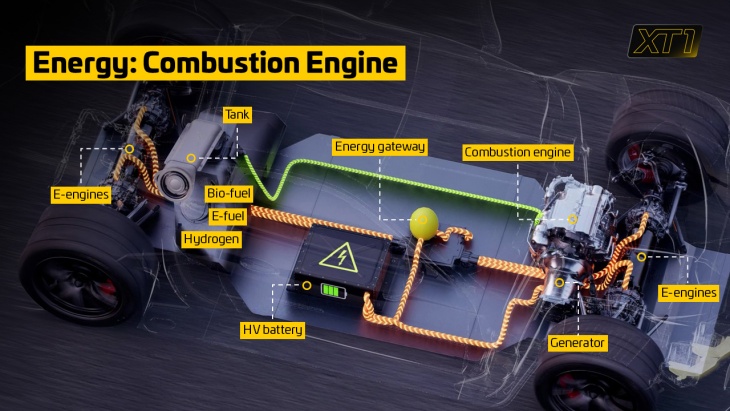
The aim is that the cars will weigh 1600kg, achieving lap times around current GT3 pace, with GT3 also acting as the benchmark for the development and running costs. The target is for the cars to be suitable for both sprint and endurance racing, and be appropriate for both factory and customer teams.
XT1 is intended as a regulation framework, rather than as rules for a specific series, with the goal of XT1 vehicles competing worldwide. The creation of a German-based series, however, was namechecked.
On the sporting front, proposals include the inclusion of push-to-pass, an active rear wing acting as an air brake, standing starts and no induced energy management.
The electric motors, inverter, transmission and central control unit will all be standardised to ensure similar performance levels, with a ‘Balance of Technology’ system acting as a leveller between different powertrain solutions.

Manufacturers would use their own chassis, with the target of 90% of the road-car silhouette being preserved. Both two-door and four-door bases would be permitted.
“Open to technology, production-relevant and sustainable – XT1 is the ADAC’s concept for the motorsport of the future,” said ADAC Sport President Dr. Gerd Ennser.
“With the groundbreaking XT1 concept, we are taking on a pioneering role by developing sustainable technical regulations that can be used internationally and that consistently incorporate production-relevant technologies. All automobile manufacturers are invited to get involved and work with the ADAC to develop a set of regulations from this concept.”
ADAC Motorsport Director Thomas Voss explained: “When coming up with the XT1 concept, we took into consideration the needs of both works outfits and private teams. XT1 is not a racing series, but a concept that can be used globally and adapted in many ways.
“It is suitable for thrilling sprint races and – for the first time – 24-hour races with electrified powertrains. The concept does not replace any existing car class, but is seen as an enhancement to the current classes, which will be able to run joint competitions on one platform in the future.”
The targeted timeline for XT1 involves the formation of a working group by the end of 2025, with a set of regulations developed during 2026. The stated aim is that the first full season of XT1 racing will take place in 2030.
Images courtesy of ADAC Motorsport