Part 2 of Michael Cotton’s 2012 conversation with David Brabham looked at a period where real success came the way of the Aussie battler!
Last week we published the first part of Michael Cotton’s interview with David Brabham. We pick up the story as David heads into the 2002 season, having spent 2001 driving the front-engined Panoz in Europe and America.
The 2002 season was frustrating. “Don (Panoz) was losing interest, there was less money, a lot of things they promised didn’t happen. And I was worried because I’d signed a three year contract with them, I’d moved my family to America and put the kids into schools, and then Don said he was going to close the team down and let us go, Jan and me.
“As soon as that happened I picked up the phone and called John Wickham, at Bentley, and told him that Panoz had let me go. He said ‘right, you’re going to drive for us’ and that of course was a completely different scenario, from a Panoz to a Bentley… it was, well, like a Bentley by comparison! All of a sudden I had my first proper chance to win Le Mans.
“We had a good race but with two delays, the first with the battery and the second, they thought it was the battery but it was something else, and we finished second, two laps down on the number 7 Bentley with Tom Kristensen, Guy Smith and Dindo Capello. We were 10 minutes behind so work it out, we could have won. We were quicker, but the Germans did a better job with the number 7. I saw how Tom [Kristensen] worked, and he deserves every bit of his success. He’s a hard worker and he knows how to get a team to win. We were the ‘British’ team in number 8 (with Mark Blundell and Johnny Herbert), and I have to say I was impressed at how the Germans went about it. As a complete working unit, they did a better job.

“It was a great achievement for Bentley to be first and second, but as I crossed the finishing line I felt totally gutted. It meant nothing to me to finish second. I went up on the podium in an absolutely foul mood because we were the faster car but Tom, Guy and Dindo had the perfect race, no delays at all.”
It mattered to David to win Le Mans, to emulate his brother Geoff, even his father, Sir Jack, who’d won the French Grand Prix on the Bugatti circuit in 1967. In time, his chance would come. The Prodrive organisation headed by David Richards set David on a new course in GT racing in 2003, first with the Ferrari 550 Maranello, then later with the Aston Martin DBR9. The Ferrari drive was in the American Le Mans Series, and it reunited David with Magnussen. They missed the first two rounds and Jan also missed the next round in Miami. “They brought Darren Turner in and we won that race. We had some very good results against the Corvettes and I finished second in the championship, so I could probably have won it.”

The 2004 season, without Prodrive who were busy preparing the Aston Martin DBR9, was a mixed season as David drove a Saleen and a Lamborghini in the ALMS, and a Zytek 04S at Spa and Le Mans. The Banbury outfit returned big-time with the Aston Martin DBR9 in 2005, and won first time out at Sebring. Turner and Stephane Ortelli partnered David in winning the GT category, beating the favourite Corvettes “and it was the most historic win because it was their first win for many years as the official Aston Martin team. Then we went on to finish third at Le Mans, not a bad result for the first time in the 24 hours.”

David drove a Panoz Esperante GT-LM for Multimatic in 2006, finishing fifth in the ALMS, also for the Team Modena and Russian Age Aston Martin teams in Europe. His career was re-energised in 2007 with two prime contracts, with Duncan Dayton’s Highcroft Racing Acura team in the American Le Mans Series, and with Aston Martin Racing to compete at Le Mans.
On the Le Mans podium
David entered a golden era at Le Mans, winning the GT category in 2007 and in 2008 in Aston Martin Racing DBR9s, and then winning the 24-Hours outright with Peugeot, in 2009. Aston Martin were, of course, locked in combat with Corvette Racing in that era, “awesome” says David, “they are very hard to beat. The only thing we had at Le Mans, we had a little bit more straight line speed, we were very good in the high speed corners, while they were good at the low speed stuff and it was very close, we would only win by a lap.” In ’07 David drove the Aston Martin number 009 with Darren Turner and Rickard Rydell, and they enjoyed a perfect race to beat the Corvette C6R of Jan Magnussen, Ron Fellows and Johnny O’Connell by a single lap, the two GT cars finishing fifth and sixth overall.
Twelve months on David again won GT in an Aston Martin Racing DBR9, again 009, with Turner and Antonio Garcia. This time they were not even a full lap ahead of the Corvette (Fellows/O’Connell/Magnussen) with less than four and a half minutes separating the two cars. Again, a perfect race with no time lost in the pits.
David was contracted to Highcroft Racing for the American Le Mans Series in 2009 but was a free agent for Le Mans, and following a conversation with Nic Minassian at the Autosport Racing Car Show in January he received a surprise e-mail from Peugeot, asking if he was free to race at Le Mans. “I went to a test in America and woke up to this text from Peugeot. Duncan said yes straight away and it took a couple of days for Honda to respond, after it went through all their networks, then they said ok and I went to Paris and got the deal done. I couldn’t believe it, another chance to win Le Mans in a top car.
“The testing was tiring, though. I was doing the American races then I’d fly over to Ricard, or Barcelona or wherever and go straight into a 30-hour test. The last 30-hour test I did I was absolutely destroyed, but it had to be done. The Peugeot was the quietest car I have ever raced and that was great for my ears. It was a nice car, I wouldn’t say it was as good as the Bentley but the power was amazing. It was a diesel of course, with incredible torque, and I had to get used to it as I was driving the HPD in America.”
Asked if there were ‘politics’ within the team, David agrees that Peugeot probably wanted a ‘French’ team to win, Montagny/Sarrazin/Bourdais in the 908 HDI in number 8 or Minassian/Lamy/Klien in number 7. The ‘étrangers’, Brabham, Wurz and Marc Gené were regarded as backups. “There were a lot of politics going on behind the scenes but I saw an advantage in that, and I think Alex and Marc did as well. The focus and most of the politics were on the other cars and that allowed us to do what we wanted to do, to make our strategy, and in the end we came out on top because we had less aggro.
“For some reason our car couldn’t do as many laps as the French car. Because of that they were much quicker than us, and were using less fuel. Anyway we had to slow up a little bit because we had a brake problem from the second stint, so we held back a bit. We could see what was happening, we knew they were trying to get the number 8 car to win and there were some very disgruntled mechanics on car number 9, they could see what was happening.” A pitlane accident set Lamy’s Peugeot back some laps and there was a delay on Sarrazin’s, resulting in both Peugeots being on the same lap in the closing stages, Brabham’s half a lap ahead, both needing one more stop. Then, an accident which brought out the safety cars gave David’s Peugeot a slender advantage, and the order went out to Sarrazin to stop pushing.
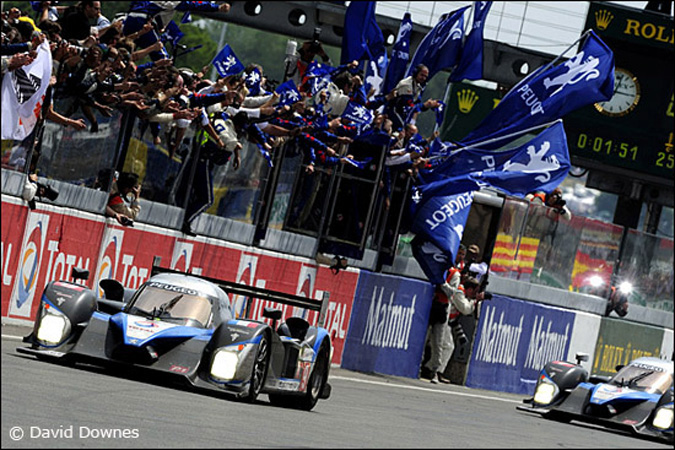
“I had been up there on the podium two years in a row with Aston Martin, and you see the LMP1 guys up there getting their trophies and their watches, and you wonder ‘what must it be like to win this race?’ And then when I went up there with the Peugeot team it was no different at all! It was such a great feeling to win with Aston Martin two years in a row, and it was no different with Peugeot, no difference at all in the feeling of elation. Well, the only difference was on Monday with all the e-mails, all the messages, the interviews, and then we went on tour to visit all the Peugeot factories. I thought I would have a break after Le Mans, I was so tired, but not a bit of it.”
ALMS titles with Highcroft’s Acura
Already familiar with all the American circuits, David’s principal programme was with Duncan Dayton’s Highcroft Racing Acura team between 2007 and 2010, bringing class wins, outright wins and two American Le Mans Series titles.
In his first year with Highcroft Racing David was partnered by Stefan Johansson in the Acura ARX-01a, against top-notch competition from the four Porsche RS Spyders raced by the Penske and Dyson teams. With a clutch of third and fourth place results they finished fifth in the LMP2 division, a good springboard for 2008. Honda and Nick Wirth really went onto the attack, “there was a big push.” The Acura was ready to win, and David passed Romain Dumas’ Porsche on the penultimate lap at Long Beach to secure Highcroft’s first LMP2 victory. Two races later he surpassed this with an outright victory at Lime Rock, driving all season with Scott Sharp, beginning a sequence of five races when the Acura was never off the podium.

“If Brabham was the best of the Acura regulars, Scott was the worst” reported Gary Watkins in Autosport, which emphasises David’s command of the Acura. “I wouldn’t say that Scott ever felt 100 per cent comfortable in the HPD so a lot was put on my shoulders” says David. “I tried to help Scott as much as I could. He was strong on street courses but he had a crash at the last race, at the Petit Le Mans, and that put us out of the running. To be fair it would have been difficult for us to beat the Porsches but we had a chance, up to the last race. They had a good race and deserved to win the title.”
Highcroft Racing reached its peak in 2009, moving up to LMP1 with the Acura HPD ARX-02a and winning the American Le Mans Series outright. Scott Sharp raised his performances to the extent that they won three races outright, at St Petersburg, Elkhart Lake and Mosport, and were never off the podium. The Highcroft team met competition at the highest level from the Acura ARX-02a of Gil de Ferran and Simon Pagenaud, who won five races but finished 17 points adrift.
Then, in 2010, Highcroft Racing repeated their triumph in the ALMS, this time with French ace Simon Pagenaud partnering David in the updated Acura ARX-01c, joined by Marino Franchitti in the endurance events. The Highcroft HPD Acura claimed four outright victories at Long Beach, Laguna Seca, Miller Motorsports Park and finally, taking maximum points at the Petit Le Mans in fourth overall, astern of two Peugeots and an Audi. These wins brought David’s tally of ALMS victories, class or outright, to 46, a record equalled by very few.
David has nothing but praise for Duncan Dayton, remarking to Motor Sport that “he is the best amateur driver I ever came across.” “That’s true. When Duncan started testing it was pretty obvious straight away that this guy could drive. He could have been a professional. He was playing around with Historics and just look at his record at Monaco, he’s won 10 times! At Sebring he caught and passed Tony Kanaan in the AJR, that guy can really drive. As the team grew Duncan was thinking less about his driving, then he did a test at Mid-Ohio, a pretty tough track, and he wasn’t on the pace. He struggled, and that was it. If he had concentrated on his driving he would have been fine but he had to keep the team going, getting sponsors and things like that, and when you have all that responsibility it’s difficult to turn it on.”
By invitation Highcroft Racing crossed the Atlantic to race at Le Mans in 2010 with David partnered by Marco Werner and Marino Franchitti. Their HPD ARX-01c ran in LMP2 against the supposedly identical HPD of Strakka Racing, but while the British team enjoyed a trouble-free run, Highcroft’s had various delays, starting when David ran over some debris from Nigel Mansell’s accident. Punctured tyres set the Acura back in the night and on Sunday afternoon the engine lost water and overheated. This was not the text-book story that David had become accustomed to. “They (Strakka) were quicker than us but we ran second most of the time, and we learned a lot. When the engine overheated near the end we had to stop and wait for the last lap, to be classified.” Twenty-fifth position and ninth in LMP2 was a poor reward for their effort.
There was a complete change of scenery for David in 2011, driving a Nissan GT-R for the Sumo Power GT team, with Jamie Campbell-Walter. “It wasn’t a great season but it got better towards the end. We had a different engineer for the first five races, the guys hadn’t seen the car before the first race and it was very disorganised. Then we got a new engineer, a Japanese who was already with the team and it started to come together. We should have won Navarra but the team screwed up and brought both cars in together for their pit stop, and we had to back up for the car that wasn’t supposed to be there.” David finished the season a passenger in a huge start-line accident in the final round, in Argentina. “The accident happened in front of me, then I got whacked in the side, pushed into the wall on my left, then the car in front of me stopped and I hit it, and then I was hit from behind.” This pinball accident left David with whiplash, a very sore neck, and ended a run of accident free races going back two decades.

In the current season David has contested the World Endurance Championship with the JRM Racing Honda HPD-ARX 03a LMP1 shared with Karun Chandhok and Peter Dumbreck. Highlight of the year, so far, has been sixth overall at Le Mans, the second petrol engined car to take the flag. “Sebring was a tough race, it was the first time the team had got the car and we missed the first practice session as they were building it. It was going well, we were up to third place and then we had a rear suspension failure.”

We are into October now, and David has no plans as yet for 2013. “Don’t know!” he says with a defiant tone. “I’ve no idea what next year is going to bring. Something will turn up, it always does!”
Many sportsmen talk of “putting something back” in the later stages of their careers, but David has been very active for the past six years running the Brabham Performance Clinics, helping young drivers with their physical and mental development. He established the clinics for the Motor Sports Association, which has become the MSA Academy. “It’s all about performance” he explains, preparing drivers to make the next step in their careers. They will not, if they listen, go to the next rung of the ladder as unprepared as he was, for Formula One, in 1990. “What they put in, they will get out of it” he explains. “If they don’t want to put anything in, they won’t get anything out.” This year his clinics have mentored nine drivers including Formula Renault stars Josh Hill and Josh Webster, who are up for the Autosport BRDC Award, and Jack Harvey, who has just won the British Formula 3 championship.
Father Sir Jack, three times a World Champion, and brothers Geoffrey and Gary, had distinguished careers in motor racing, but over a period of 30 years David’s achievements, in victories and titles, have left them a long way behind. He will probably not emulate his father’s knighthood, awarded on the Australian list of honours, but if ever a man deserved a Queen’s honour for services to motor racing, it is David Brabham.