


What drives someone to start up a brand-new racing series at a time when nothing in motorsport was certain?
“That’s a great question, one that my wife asks me often,” says Chris Bye, a veteran of four decades of professional motor racing as a driver and team owner, a successful event promoter in the Canadian automotive industry, and since 2021 – amid the pandemic – the president of FEL Motorsports.
Bye had a dilemma at the time: His main business, FEL (Franczak Enterprises Canada), had gone from planning and promoting nearly 800 events per year for premium automotive brands to just 19 by the time the world as we knew it shut down on Friday the 13th of March, 2020. Without any in-person car launches or promotional events, he needed to keep his company’s 20 full-time employees on board somehow.
And then he got to thinking about the state of Canadian motorsport, which once had a thriving national racing scene. Bye would know – he was driving in that golden age of Formula 2000, GM Challenge Series, and Porsche Turbo Cup. He was a team-mate of the likes of Scott Goodyear as a driver, and he saw other young talents like Jacques Villeneuve, Scott Maxwell, and the late, great Greg Moore begin to proliferate international motorsport.
But even before the pandemic had settled in, Canadian national motorsport had entered somewhat of a state of depression – compared to those cigarette-and-beer-backed glory years.
“There was just a ton going on. And then it all stopped. So I’d been thinking, ‘Where is the next Zacharie Robichon gonna come from?’ Because there was no homologated racing in Canada,” Bye said of the state of Canadian domestic racing at the time. “There were a couple of homologated series, but they were running with non-homologated cars, and it was kind of a hodge-podge, I’d say. There wasn’t a clear ladder. There was just no structure.”
Not long after young Zachary Vanier won the final Canadian Touring Car Championship title in a FEL-owned, Pfaff Motorsport-prepared Audi TCR, Bye began laying the groundwork for FEL Motorsports and its two championships: The Sports Car Championship Canada and the Radical Cup Canada.
“A bunch of the sports car teams and Radical teams started calling me, we got some momentum going – and we said, hey, let’s give it a shot and see what happens. I don’t know if it was the best financial decision I’ve ever made…but we’re going in the right direction, coming up to year five, and we’re pretty excited about it.
“For years I’ve always asked myself one question, and that question is: ‘What would Roger (Penske) do?’ And I ask myself the same question in motorsports. The answer is easy. You know what Roger would do. The difficult part is doing it. It is possible to make money in motorsports. It’s just way more possible to lose money, I guess I’d say!”
Heading into the 2025 season – the fifth year for SCCC and RCC – Bye continues to strive to make his series a destination for promising Canadian talent to have a relevant place to race and pursue their dreams of competing on a bigger stage.
Asked if he believes that the two series have achieved their stated goals, Bye said: “There’s no question. Our goal was to give Canadian drivers a path to bigger and better things. That’s IMSA, SRO, going to WEC – whatever that looks like. And we came out of the gate immediately proving to ourselves that we were doing things right.”
The proof is in a growing list of series alumni who’ve gone on to achieve those goals in the four years since FEL Motorsports launched. Vanier, Marco Signoretti, Jack Polito, Dean Baker, Jake Cowden, Jonathan Woolridge, and Demi Chalkias are just some of the people that have leveraged SCCC or RCC success into opportunities in IMSA or SRO America-sanctioned series in recent years.
“And although it’s sad to see teams leave us, that’s why we started this series, to give them a launching pad,” said Bye. “I think we’ve proven the point. The success in our series leads to success outside of our borders.” And it wasn’t just the young drivers and the privateer teams that took notice of what Bye and his group were doing.
“When we started the series in our first year, Multimatic ran Marco Signoretti, as a factory effort. And Larry Holt said, ‘For the first time in decades, Multimatic has a reason to race in Canada.’ That’s a statement, and a feather in our cap, that we are very proud of. To have the support of Larry and Sean [Mason], it means a lot to us.”

Bye formed SCCC as something of a feeder series for the IMSA Michelin Pilot Challenge with a similar class structure of entirely homologated GT4 sports cars and TCR touring cars. By year three, ready-to-race TCA cars had joined the category, and in year five, they’ll be joined by a GT3 Cup class that will fill the void left behind by the loss of Porsche GT3 Cup Challenge Canada.
But having a series entirely comprised of homologated cars is something that Bye firmly believes is the best way for drivers to showcase their true talent.
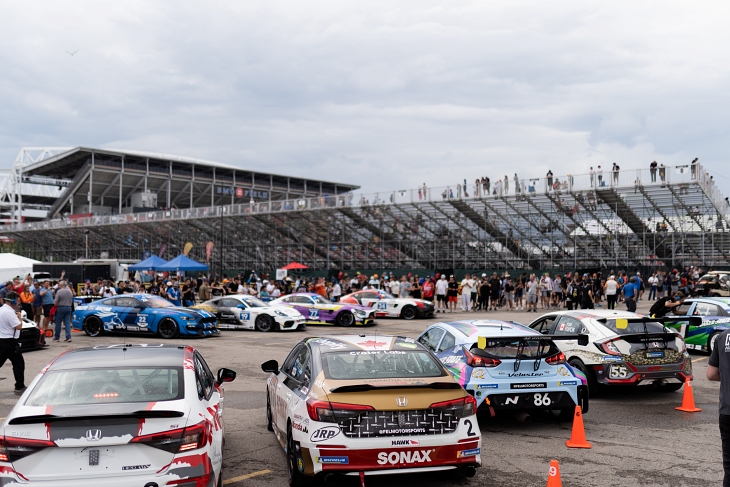
“If you’re in a non-homologated series, you can’t really gauge what a driver is doing,” Bye explains. “At the Honda Indy Toronto last year, our top eight TCR cars qualified within four-tenths of a second, with four different brands. That teaches the teams to strive for every little advantage they can get through setup. The drivers, you know – it takes them three to four laps to pass somebody, it forces them to race clean because there’s penalties when they don’t. And I think it’s a really great proving ground. It’s not like you’ve got a car that’s got 200 more horsepower than someone else, and just blasts by them up the straight and hangs on in the corners.
“I got my professional racing license in 1977 – and back then, there was a clear path to open-wheel or sports car racing. You picked one and went down that path. But nowadays, there are so many opportunities for people to get on track, that for a professional driver, the waters can get pretty muddy. So if it’s not homologated racing, it’s really hard to judge driver talent, I think. The bottom line, if you win – whether it’s the TCA class, or TCR, or GT4, if you win a race in one of our series, you’ve earned it.”
Now that the successful groundwork has been laid, Bye has recognised and reacted to the prospect of dwindling grids with multiple changes, including the addition of the GT3 Cup class to SCCC – a change that will finally give about 30 to 40 orphaned Porsche Cup cars a place to race in a controlled environment for the first time since GT3 Cup Challenge Canada folded.
“I think there’s lots of excitement – talking to the Porsche guys, the ones we’ve talked to are pretty excited about a structured place to come to race again.
“We started talking to some of the Porsche guys and they were like, ‘Man, we’d love to have a place to race!’ The problem for them to go to a club race, is that these cars are still worth a significant amount of money. And club racing needs to have its place. But you can be out there in cars, $10-25,000 cars – are you gonna put your $200,000 car on track with them? It can be very risky. And there’s already a high enough risk.”
The addition of this category should also help get SCCC get to 25 cars per weekend, which Bye has said is the magic number to make the math and the investment work out.
“In Canada, we have one-tenth of the population of the US. If the US, has 20 cars, mathematically we should have two. So we’re super happy our TCR grids are similar to those of Michelin Pilot Challenge, which we’re super proud of.
“It’s simple maths. A series cannot survive on 10, 12, 14 cars. Mathematically, it doesn’t work. We need to have in the range of 25 to make it work.”
“And adding GT3 Cup to the series – we can’t add cars and then take six cars away,” he says, talking about the decision to continue the TCA class – even after it’s been cut from the SRO TC America series from which it originated. “We’ve reached out to some of the US teams and wanna give them a home to come and race.”
It gives teams a more cost-effective outlet – at nearly one-sixth of the cost to buy a new TCR car – to go racing, and should also allow programmes such as MD Racing’s female-forward Hyundai TCA entry to continue racing for the foreseeable future as it did last season.
There’s also been a positive response to the series’ 20 per cent entry fee reduction, not just for SCCC but RCC competitors as well. “My phone was blowing up! It’s super positive,” Bye exclaimed.
“When we came out of the gate, we had to knock it out of the park. It couldn’t have just been okay. We needed to go, okay, this is different and better – but we needed to walk the talk. We made significant investments to make sure this was done right.
“We know what those customers want. I think we did a really awesome job of doing that – of making it right, and giving these guys a platform that they can be super proud of.
“And now, our job is to make the series more accessible,” he continued. “I think we set the benchmark. This is a destination if you’re a young, up-and-coming Canadian driver, and you want a place to hone your skills.
“Now that we’ve set the platform, we have to make it more accessible. And that’s where the decrease in entry fees has come from. With lowering entry fees comes some other difficult choices, decisions that we have to make. Racing is never cheap, and will never be cheap. We know that.
“But I can’t think of another series anywhere in the world that’s said, ‘Oh by the way, our entry fees are going down by 20 per cent!’ I think it’s pretty big news.”
Sports car racing at this level lives and breathes through its customers and competitors, but Bye has made it clear that he wants his series to be as fan-friendly as can be – again, pulling from his background in the civilian automotive world and his ‘WWRD?’ motto.
The series is in negotiations with its production partner to set up professional-quality live streaming of most – if not all – races in 2025. For the fans in attendance, Bye looks to what IMSA has done for fan engagement as inspiration. Allowing fans to get up close to the cars, driver autographs, ticket giveaways on social media, and even a T-shirt cannon.
“In my professional and my personal life, I’m a firm believer that if you want to be successful at something, look what the successful people do, and do that. I know I’m not nearly smart enough to figure it out on my own!” he laughs.
“IMSA does an amazing job, John Doonan and his team have built such an amazing travelling show for fans, and we are doing everything we can to emulate that in Canada.
“In no way, now or ever, are we ever trying to compete with IMSA or SRO. That’s not where we’re at. We very much will remain a feeder series.
“But we wanna be able to give our fans a guy like Zachary Vanier, where they can go to Montreal F1 and run into Zach in the paddock and say, ‘Hey, I remember watching you in FEL!’ That’s a success story for us.”
Images © FEL Motorsports


