
The 2026 Rolex 24 Hours at Daytona has been declared a success by powerhouse German manufacturer BMW, after strong showings from Paul Miller Racing and Team WRT delivered headline results in two different classes.
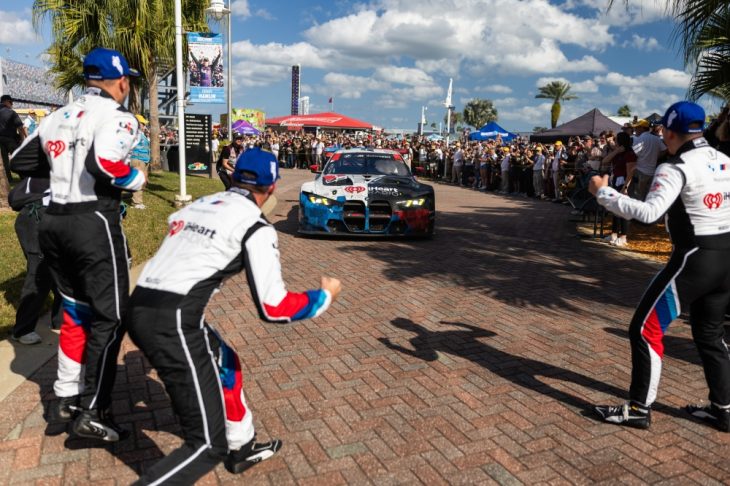
The standout result came in GTD Pro, where Paul Miller Racing claimed victory with its #1 BMW M4 GT3 Evo in one of the most fiercely contested fights the category has ever seen. Dan Harper brought the car home just 2.2 seconds clear of the 75 Express Mercedes-AMG, which formed part of a double podium for BMW’s rival brand, completed by the #48 entry from Winward Racing.
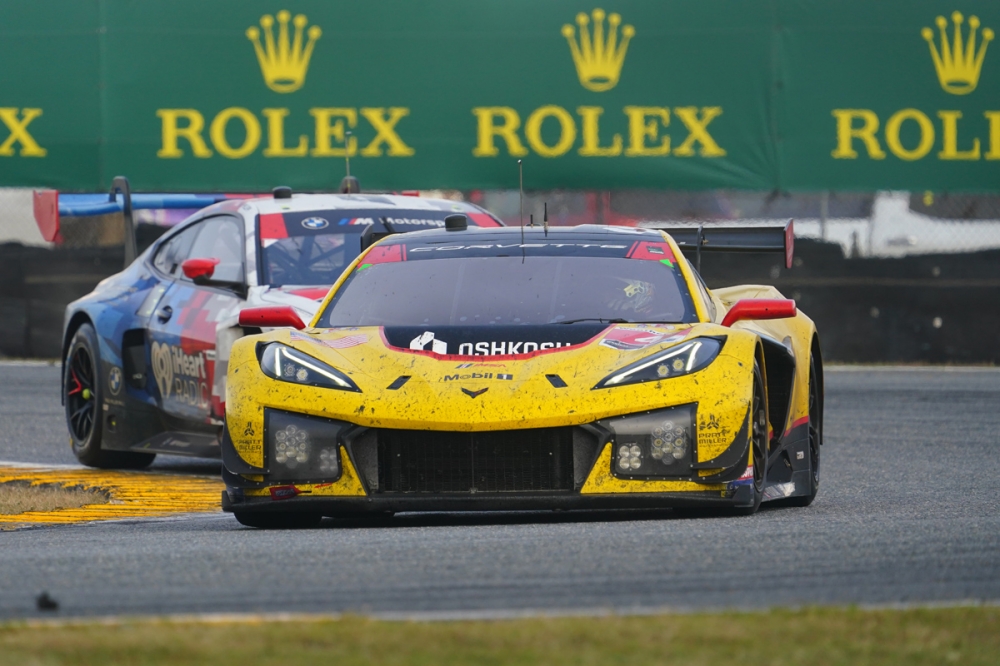
Early stages of the race had suggested Corvette Racing could be the team to beat on Sunday afternoon, with both Z06 GT3.R entries running strongly at the front in the opening hours.
However, neither Pratt Miller-run car would ultimately feature on the podium. The #3 entry was delayed by a suspension issue, while the #4 was forced off the circuit during a late-race restart, an incident that could drop it way out of contention.
Those twists opened the door for a redemption story for Paul Miller Racing at Daytona. Returning to the scene a year after its well-documented clash with Corvette — an incident that produced the iconic image of Tommy Milner gesturing toward Augusto Farfus — the team had scaled back to a single-car effort for 2026, but not its ambition.
Despite the reduction in car count, Paul Miller Racing executed a strategy that proved spot-on, with the driver line-up of Dan Harper, Max Hesse, Connor De Phillippi and Neil Verhagen delivering when it mattered most.
“The team throughout the whole race were doing a great job managing all the pit stops. The strategy was always good,” said Harper, who handled the final stint under intense pressure from Maro Engel behind in the closing laps.
“We decided to go full push, I think it was my second-to-last stint. I came out a good bit behind the three leaders, which at that time was the Manthey car, one of the Corvettes, and the Merc, so we decided to go full push behind them, cut the stint short to get enough fuel to get to the end, and just hope there was no yellow where those guys would stop and get fresher tires.
“We took that gamble, and it paid off. We got the track position, which, to be honest, has been really key for us this weekend. We’ve struggled when we’ve been behind those cars to get a move done. We’ve always sort of come close to getting it done, and then maybe on the brakes or the infield section, they’d just gap us a little bit again.
“It was crucial to get that track position for the last stint, and yeah, the boys pulled it off.”
BMW’s weekend was further bolstered by its factory GTP effort manned by Team WRT, which secured a third-place overall finish with the updated BMW M Hybrid V8.
Achieving a win on its GTP debut was always going to be a tall order for the Belgian squad in a hyper-competitive class packed with factory-supported entries. Team WRT is still adapting to the IMSA ruleset while simultaneously operating a second flagship manufacturer programme from a new base located thousands of miles from its European headquarters, making immediate success an unrealistic expectation.

That context did not stop the experienced and highly decorated team from pushing hard for a podium finish. Both entries showed promise during the race, but by the chequered flag, it was the #24 car that emerged as the stronger contender, finishing third overall with Dries Vanthoor at the wheel in the run to the flag. While Penske’s Porsche’s ultimately remained out of reach, the result deserves to be celebrated, as it marked a strong start for WRT in North America and ensured that three different manufacturers were represented on the overall podium.
“We could not dream of anything better,” Team WRT boss Vincent Vosse told DSC. “Our expectations were not so high after qualifying, but we kept our heads down, and we turned the situation around. To have a competitive car to deliver a podium was great.
“Both cars could have made it, but unfortunately, we went with a different strategy with the #25 that didn’t work for the drivers, who drove a flawless race.
“The biggest learning point is that Porsche has been dominant and this is what we expected from the first day of the Roar. After Quali, we knew they’d be strong. Luckily, we understood our issues in time for the race and gave ourselves a strong car for the race.
“It wasn’t the fastest, but we were in the fight. At the end, you see how many mistakes and penalties come. You have two races: a 22-hour race, then a 2-hour race, and I feel we ultimately succeeded in both.”
The Rolex 24 also served as an important early proving ground for LMDh manufacturers running updated machinery. Despite the extensive track time available over the event, the picture remains far from complete. Even so, Vosse believes the revised M Hybrid V8 showed encouraging signs, boosting confidence ahead of the Sebring 12 Hours and the FIA World Endurance Championship season opener in Qatar in March.
“It’s difficult to judge, but I think we made a step,” he concluded. “It’s working, but we need to understand the car. Luckily, we are doing WEC and IMSA, so we are learning twice as fast.”
Images courtesy of BMW