Only four French drivers have scored more than one win in the 24 Hours of Le Mans since World War II, and only one has ever managed to win with two different French manufacturers. That man was Jean-Pierre Jaussaud, a driver whom countless fans associate with the glory days of French motorsports in the 60s, 70s and 80s.

The Frenchman recently released his memoirs in a book entitled Ma Vie de Pilote (My Life as a Driver). He has kindly accepted to reflect on his past with DSC and discuss the highs and lows of his career in Le Mans.

The 60s: Dangerous Years
“It all started in 1964 and not in the best way. At that time, I had only raced 2 CVs and done a handful of Formula 3 races. Jean Redélé, the founder of Alpine, had seen me racing, and I guess I had impressed him. He invited me to Le Mans for a test drive. I was definitely excited: it was my first time on the mythical track and my first time driving a Le Mans coupé.
Unfortunately, my excitement disappeared rather quickly. On my very first lap, I immediately felt I could not manage the Alpine. It understeered and tacked so much that I almost lost control of it before the Hunaudières and spun out at Mulsanne.
On my second lap, I was so focused on keeping the car on the track that I forgot about being fast. I remember arriving at the Tertre and realizing that I had been in third gear since the start/finish line. So I ultimately thought it was better to return to the pits. I got out of the car and told Mr Redélé: ‘Look, I’m sorry, but I can’t do this. Your car is dangerous, I’m claustrophobic… it’s not for me.’ You can imagine the look on his face, but I was right: the driver who got in that car right after me that day drove a few miles and had a big accident.”
In 1965, Jaussaud became a works driver for Matra in F3. A year later, the French manufacturer announced its intention to win the 24 Hours of Le Mans and entered three prototypes, including one for Jaussaud and teammate Henri Pescarolo.

Although the car did not complete the race, Jaussaud’s contract was extended in 1967, the year Matra released a new prototype: the Matra 630. Its development was assigned to Jaussaud and Roby Weber:
“Roby and I were competitors in F3. I had been faster than him, but he was still eager to show me and the director Lagardère that he was the best. We were both called in for a test session in Le Mans, with Roby being assigned the previous year’s model and me the new 630. It was quickly clear to me that this new car was dangerous. We tried different set-ups all day long, but nothing was working. I would come close to losing the car in straight lines as soon as the engine would reach 8000 revs in fifth gear. As I was trying to figure out what was going on, I looked into my mirrors and finally understood why I could see the sky instead of the road: past a certain speed, the rear of the car would elevate in the air. Back in the pits, I explained this to the team, but they simply would not believe me.
Roby eventually sneaked into the 630 and probably thought it was the right moment to impress Matra’s management. As he was about to leave the pits, I advised him not to go beyond the 8000 revs limit. The car left the pits… Roby never came back”. The driver lost control of the car on its first lap and was killed upon impact. A witness of the fatal accident later confirmed Jaussaud’s diagnosis. Before the car left the road, he heard the Matra engine pick up revs, as if the rear wheels had suddenly lost contact with the ground. Despite this tragedy, Jaussaud and Pescarolo raced the Matra 630 in the 24 Hours of Le Mans 1967 but did not finish.
Jaussaud eventually left Matra at the end of that season, in absence of a good racing proposal for 1968. “Dealing with Jean-Luc Lagardère, the director of Matra, was not always easy,” he says. “He had its favorite drivers. I might not have been one, hence the reason why it was sometimes hard to get my point across. Take the example of Roby’s accident: no one listened to me when I said the car was dangerous. Had it been Beltoise [the team’s favourite], the 630 would have stayed in the pits.” Jaussaud would remain absent from Le Mans for six years until he was welcomed back by Matra for the 1973 edition of the 24 Hours of Le Mans.
1973-1977: Within Victory’s Reach
For the first time in his career, Jean-Pierre Jaussaud had the opportunity to win Le Mans alongside Jean-Pierre Jabouille. The heavy Matra 630 (“A car I really hated,” he recalls) had long been gone and was replaced by the 670, the winning car in 1972.
A few hours into the race, the car was cruising in fifth position. Jaussaud was driving full throttle when one of his front tires exploded just before the Hunaudières right-hand curb. Miraculously, he managed to keep the car on the track but could not avoid damaging the front suspension. “I was trying to get back to the pits,” he remembers, “but as I was so slow, the mechanical fuel pump was not doing its job anymore. Consequently, the engine kept shutting down.
What I would do then was get out of the car, lift up its rear to get some petrol flowing to the engine and then continue to drive a few hundred meters until the engine shut down again. I must have lifted that car in seven or eight different places on the circuit until I finally reached the pits. Obviously, we lost a lot of time. When we went back out on the track, we were in 39th or 40th position.”
After an epic battle, Jaussaud and Jabouille ultimately finished the 1973 race in 3rd position, right behind the Ferrari 312PB of Arturo Merzario/Carlos Pace and the winning Matra driven by Henri Pescarolo/Gérard Larrousse.

Jaussaud remained with Matra in 1974, when he was joined by Bob Wollek and José Dolhem. In the early hours of Saturday evening, as the car held second position, the engine unfortunately ended up dying. Even though teammates Pescarolo and Larrousse won the race, the 1974 edition was one for Jaussaud to forget.
In 1975, new fuel consumption regulations were introduced in the 24 Hours of Le Mans. Since Matra had withdrawn from sportscar competitions, only two teams could realistically aspire to victory: Guy Ligier and the JS2 Cosworths, now engineered by ex-Matra driver Gerard Ducarouge, on the one hand and John Wyer and the Gulf Mirage GR8s on the other.

At the very last minute, Jaussaud received an offer from Wyer alongside Australian driver Vern Schuppan. Starting second on the grid behind Jackie Ickx and Derek Bell in the sister Mirage, the car led the race for several hours until a problem with the alternator ruined any chance of victory. Jaussaud/Shuppan ultimately finish third behind Ligier in second position and Ickx/Bell in the winning Gulf GR8 Mirage.
That same year, a young native of Le Mans named Jean Rondeau decided to build his own car in order to compete in and ultimately win the 24 Hours of Le Mans. He shared the same dream with a few friends, including Michel Beaumesnil (the father of Vincent Beaumesnil, currently the manager of ACO Sports).
“My early memories of Rondeau’s project evolve around Beaumesnil presenting me a small model of the car carved in wood,” Jaussaud recalls. “There was really not much besides that at the time. But soon [former F1 driver] Vic Elford joined the adventure, and cash started to flow into this project with the support of Inaltera, a wallpaper manufacturer represented by a charismatic person named Charles James.”
Most of the members of Rondeau’s team were essentially beginners. Yet, Rondeau, Elford and James’s power of persuasion convinced some of the best French sportscar drivers of that era, including Jaussaud, Pescarolo and Beltoise. Two Rondeau Inaltera cars were finally built to race in the GTP class for the 24 Hours of Le Mans in 1976. One managed to score a victory in its class (Beltoise/Pescarolo placing 8th overall).
Unfortunately, Jaussaud was not in the winning car yet again (he finished 21st overall), but he was still impressed by Rondeau’s team.
The 1976 edition of the 24 Hours of Le Mans also saw the arrival of another French manufacturer: Renault with the Alpine A442. The car showed a lot of potential. Despite not finishing the race, the innovative turbo-engined car managed to secure the pole position and did the fastest lap during the race. Jaussaud understood the car’s potential and literally badgered his former Matra teammate and newly nominated Renault team manager Gérard Larrousse about driving it in 1977.
Jaussaud was eventually assigned to a significant stage in the car’s development: “The Renault A442 was one of my favorite prototypes along with the Rondeau M379B (on which he also won). I covered tens of thousands of kilometres while testing it behind the wheel. At Renault, I was one of the drivers who knew that car the best.” Unfortunately, turbo-charged technology was still fragile in 1977. Renaults were fast (making pole position in the second consecutive year), but their engines could not last for twenty-four hours. There was a sign, however, that victory was near: the winning Porsche driven by Ickx/Barth/Haywood barely crossed the finish line with an engine running on five cylinders instead of six.
1978-1980: Victory at Last!
Jean-Pierre Jaussaud remained in charge of the Alpine’s A442 development during the 1977-1978 season. Before Le Mans, he was partnered with rising F1 star Didier Pironi: “I had met Didier a few years earlier at Nogaro. You could see he was really quick. He impressed me, but I noticed he was quite brutal with his car to the point where, in some corners, all four wheels weren’t even touching the ground. So I kindly went to see him and said, ‘You know Didier, if you adjust the set-up of your roll bars, the four wheels of your car will stick to the track, and you will end up being faster’. He replied, not so nicely, ‘That is the way the car is set up, and that is the way I want it’.
My remark had obviously annoyed him, so when Larousse told me that we would share the car for Le Mans in 1978, I thought about that first encounter. The last thing I wanted was to have Didier fighting with me to be the quickest instead of preserving the car, which we knew had improved compared to 1977 but which was still fragile. So, in order to avoid any confrontation between egos, I always let Didier be the fastest one at the wheel on purpose.” The car ultimately showed weaknesses with the gearbox and clutch towards the end of the race… wise move.

Renault ended up dominating the 24 Hours of Le Mans in 1978, beating Matra’s record for distance and setting a new lap record. The victory made a huge impact on the French public. After the race, Pironi and Jaussaud even drove the winning car down the Champs-Élysées, a rare privilege that only Alain Prost had the opportunity to experience behind the wheel of his McLaren TAG Porsche after winning his second F1 championship in 1986. Jaussaud admits that it was “incroyable”.
Following this triumph, Renault decided to put an end to its Le Mans adventure and focused its attention on the F1 program, which Jaussaud also supported as one of the first ever F1 test drivers.
After a disappointing 1979 edition of the 24 Hours of Le Mans behind the wheel of an old John Wyer Mirage shared with Vern Shuppan (the car did not finish), Jaussaud was back at Rondeau for a memorable and emotional race in 1980.

“It all started with the qualifying session,” he says. “I was sharing the car with Jean Rondeau, and throughout the session, he simply could not establish the right set-up for the car. He would leave the pits, do a few laps, come into the pits to get something fixed and go back out over and over. All of a sudden, the team realized I was still not qualified with only fifteen minutes to go in the final session, so we obviously had to rush: I did one warm-up lap, then a single flying lap, all by night. We placed fifth on the grid, but that was a first close call for the week.”

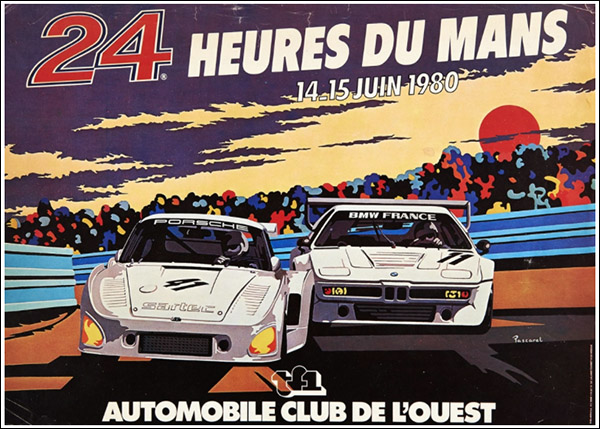
That 1980 edition of the 24 Hours of Le Mans was a classic, with a non-stop battle between the two Rondeau workscars driven by Pescarolo/Ragnotti and Jaussaud/Rondeau and Ickx/Jost at the wheel of the Porsche, triggering twenty-nine changes for the lead in twenty-four hours. The race was marked by many rainy episodes, leaving leaders stuck in gravel traps or leading them to run into tire walls.
“If you recall,” says Jaussaud, “there were two Rondeau works cars with one fully sponsored by ITT and ours by the magazine Le Point. We had changed the front of our car so often that we ran out of spares. As a result, we had no other choice but to take some parts from the sister car. That is why our car ended the race with ‘ITT’ on the front instead of ‘Le Point’. Jean and the sponsors had never planned for such a scenario!”
In the final hours of the race, Jacky Ickx was rapidly closing the gap with the leading Rondeau driven by Jaussaud/Rondeau. At the end of the twenty-third hour, he even recovered close to one minute a lap on Jean Rondeau.
“We had to bring Jean in, as something was not right and we were in danger of losing the lead,” says Jaussaud. “I did not know it at the time, but Jean was paralyzed with fatigue and stress.” Jaussaud got in the car and managed to stabilize the gap with Ickx until…“I got out of Arnage on slick tires. Suddenly, I saw a marshal going to great lengths to show me that there was a huge puddle of water. So I instinctively dropped a gear. A second later, the car was spinning, and my four wheels were in the grass. The spinning stopped and, luckily, I did not hit any walls. My concern was that we had had problems with our starter all morning long: each time we were in the pits, we could only ignite the engine unless someone cooled it down by pouring buckets of water on it. Well, I was right to be concerned.
First attempt, nothing. Second attempt, nothing. At that time, I really thought, “Sh**, you blew it. It’s over.” But then I thought I would hold a little. Jackie was close, so I knew I did not have long. After waiting fifteen seconds – probably the longest fifteen seconds of my life – I tried it again. Miracle! The engine roared!” That was the final dramatic episode of the 1980 race. Alongside Jaussaud, the French driver and Le Mans native Rondeau had ultimately won with a car he had created. “That was the most beautiful day of my life,” recalls Jaussaud. David/Rondeau had finally beaten Goliath/Porsche.
Jaussaud ended up racing in a Rondeau car again in 1981, 1982 and 1983 (below) but would never again have a car that would allow him to complete the 24 Hours.

“After 1983, I no longer had solid backing for Le Mans, so I retired from that race. But I gave it one last try in 1991,” Jaussaud says with a big grin. “Peugeot was returning to Le Mans so I thought I would call Jean Todt. On the line, I said, ‘Jean, I have always won with French cars of which the brand name ends phonetically in ‘o’. Sounds like Peugeot and I are a good idea, don’t you think?’ He obviously did not think much of my offer, since he recruited F1 drivers instead of me. They won anyway, so I guess he was right!”
Jean-Pierre Jaussaud took his final international racing license in 1992 but was still racing in Clio Cup until 2012 – an astonishingly long career. He is now a busy retiree supporting his son Eric in the organization of go-karting endurance events.
Mat Fernandez (@matlemans)