Continuing Michael Cotton’s interview with John Fitzpatrick, started yesterday, here…
Four golden years in the States
John Fitzpatrick’s career moved in a different direction in 1980, thanks in the first place to Dick Barbour. The American had ambitious plans, running two Kremer 935 K3s, one in the States and one in Europe, and naming the Englishman as his lead driver. Barbour had himself finished second overall at Le Mans in ’79, with Rolf Stommelen as his lead driver and actor Paul Newman drawing the adoring attention of the crowds, and this inspired him to ramp up his activities.
Daytona was a race to forget, but Fitz and Barbour then won the Sebring 12 Hours, in fact this was the third successive victory at Sebring for Dick Barbour Racing’s Porsches, but the first for the owner as a driver.

Fitz reckons he drove nine of the 12 hours, which makes his success all the more creditable. After that, Fitz won six more IMSA GT races, seven out of 14 rounds to clinch the series title by a comfortable margin, ahead of reigning champion Peter Gregg. One record that remains in the books is his average speed of 120.469 mph in winning the Daytona 250 IMSA race in April 1980, including a pit stop.

Successes included winning the Los Angeles Times Grand Prix, partnered by Barbour (above), and the World Championship round at Mosport Park, partnered by Brian Redman.
In Europe, Fitz drove a Dick Barbour Porsche to victory at the Norisring, the big stadium race which always draws big crowds, and reached second place in the 1,000 Kms race at the Nürburgring.

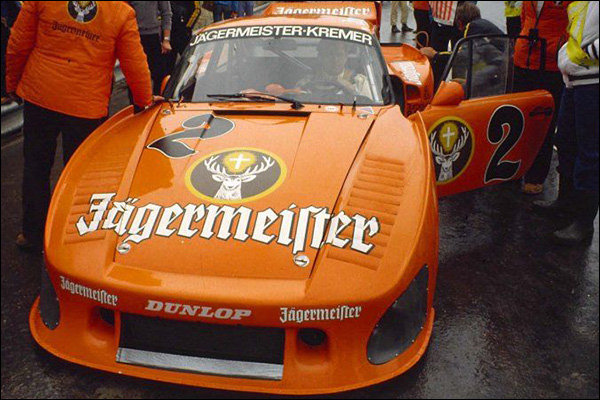
He also drove the Jägermeister sponsored Kremer Porsche in some events, with a tally of three wins, and was awarded the Porsche Cup for the third time. Bob Wollek’s record of seven Porsche Cup awards may never be matched, but Fitz lies second in the league on three, ahead of Franz Konrad and Klaus Ludwig on two.
Le Mans 1980 was a race that got away. “It was horrendously wet, and we led the race for a long time but then had a problem and dropped back.” We, being Fitz, Barbour and Brian Redman. Jean Rondeau won the race and the Barbour Porsche 935K3 eventually finished fifth, winning the IMSA class, a satisfactory result.

Towards the end of 1980 Barbour ran low on sponsorship and had to close down his team. “I decided to do my own thing” says Fitz, who invested his savings in a Kremer Porsche 935, along with Barbour’s workshop and staff in San Diego, and established his team as John Fitzpatrick Racing. ”Sachs wanted to continue, and Jim Busby wanted to drive with me. He’s a really nice, fast guy and he had some sponsorship, from Cox Newspapers, and he did the whole season with me.” Fitz and Busby won the second race of the season, at Road Atlanta, and again won the Los Angeles Grand Prix. As team owner, Fitz finished third in the IMSA Camel GT Championship.

“The Sachs sponsorship just about covered the cost of running the car, and I had support from the Kremers, but I always needed more. Joe Hoppen offered me a spare engine which I realised was clapped out, a complete joke. I think he resented Dick and me because we beat Peter Gregg, who he was sponsoring.”
Fate took a turn here. “During the winter, in the middle of the night in San Diego, Peter Gregg called me, asked if I would be interested in running a team with him in 1981. I gave it a bit of thought and decided not to do it, and the next thing I heard, he had taken his life. I felt guilty about that. Would he have lived if I had agreed to drive with him, given him a goal to carry on? I will never know. Shortly afterwards Bob Snodgrass, who had taken over the running of Brumos Porsche, offered me a modest sponsorship for the IMSA championship, which I carried on the car in ’81. I had put all the money I had earned the previous year into it, but I desperately needed a good sponsor.”
Fitzpatrick was settled in San Diego with his wife, Sandra, and their two sons, John-Mark and James. Both had been born in America and have American passports. Life was good, so long as there was enough money coming in to support the team and make a living. Fitz knew, and maintains, that there was a lot of drug money in the sport but he neither had any of that, nor wanted it.
Out of the blue came J David
The last race in 1981 was at Daytona, and Fitz had decided not to compete. He had run out of serviceable engines, and could not improve his third-place position in the IMSA championship. “And then I had a phone call from Jerry Dominelli, a Porsche fan, who had plush offices over the La Jolla Bank in San Diego. He invited me to go and see him, asked me what I was going to do next year. What did I want to do? I didn’t yet know, but I said I’d like to carry on with IMSA, I’d need a different car for that, I was thinking of buying Kremer’s 935K4, and Porsche were bringing out a new car, the 956 for the Group C, I’d like to do that.
“He asked me how much it would cost. I told him I thought three million dollars to do IMSA, Group C and Le Mans. He said, ‘OK, let’s do it. Put some figures on paper, come back after you’ve been to Daytona.’ I told him I wasn’t going to Daytona, I didn’t have a good engine. “Oh you’ve got to go. How much will a new engine cost?’ I told him 50 or 60 grand, whereupon he wrote out a cheque for $50,000. ‘Go to Daytona, let me know how you got on.’”
This offer sounded too good to be true. Here was a currency dealer, a sharply dressed man in a pin-stripe suit, who was in his office at six o’clock every morning, a Porsche enthusiast, he said, wanting to be the saviour of John Fitzpatrick Racing.” Sandra quelled his doubts, telling him to present the cheque and see how far Dominelli’s generosity would take the team.
Fitz presented the cheque first thing Monday morning, luckily at the same bank where Dominelli had his accounts.” A minute later the young lady said ‘that’s ok, Mr Fitzpatrick, the money is in your account.’ We bought the engine, went to Daytona, and then I went back to see Dominelli to talk about plans for 1982. We knew that Porsche were bringing out the 956, but we couldn’t have one straight away, so we went to Joest who was bringing out a special 935, like Moby Dick, and we also bought a K4 from Kremer for something like 200,000 dollars, a bit less than the 956 we couldn’t buy, and we went ahead for the season.”

The Kremer K4 had a spaceframe chassis, as did the Joest 935. However Joest’s car had twin intercoolers, and less drag, the idea generated by the 936 Group 6 car which Joest owned (it raced at Le Mans in 1980 as a 908/4, to deceive Porsche’s boss Ernst Fuhrmann). “We could have bought another type of Group C car, a Lola perhaps, but we didn’t want to do that, we loved Porsches. It was a Porsche or nothing.”
Fitz ordered a 956 for delivery in 1983, the first released by the factory, and meanwhile went racing in 1982 with the Kremer Porsche K4, in Europe and in America, and alternating with the Joest 935. “The K4 was a sensational car, the fastest 935 ever, and still is.” Partnered by David Hobbs, Fitz drove his Joest 935 ‘Moby Dick’ to fourth place overall at Le Mans, the first finisher behind the three debutant Rothmans-Porsche 956s, and won the IMSA GTX class. The name of J David was prominent, and his backer was well pleased with the publicity.

John Paul, the Dutch-born race driver, and his son John Paul Junior fairly dominated the IMSA Camel GT Championship in 1982, winning Daytona, Sebring, Road Atlanta, Laguna Seca and Charlotte straight off, either individually or as a pairing in their Porsche 935, save for a win by Ted Field at Riverside.

Come Mid-Ohio, though, in the 100 Mile race Fitzpatrick was a clear winner in his K4, beating JP Junior, but the Pauls had a new weapon to bring to the next race at Lime Rock, a Group C Lola T600 Chevrolet in which Junior gained pole position. Fitzpatrick would start the race alongside, on the front row, with JP Senior behind him in his 935.
“Dominelli only came to a couple of races, something always cropped up that kept him in his office, but he did turn up at Lime Rock in a big black stretch limo. I had a good start and was leading Junior in his Lola, when we came up to lap Senior in his 935. He saw me coming and made it difficult for me to pass. Dominelli saw this and began cursing, and the next lap he was on the wall with the mechanics. I’d got past Senior when we came round, and then Dominelli is yelling at him ‘you son of a bitch’ and hurled a wrench at his windscreen! The mechanics had to bundle him off the wall and out of sight, it was hilarious!”
Later, Fitz had back-to-back victories at the Road America 500 Miles and the Mid-Ohio 6-Hours, both times partnered by David Hobbs, and finished the season third in the IMSA championship, behind JP Junior and Ted Field.
The 1983 season was fateful for John Fitzpatrick Racing, majoring as he did in the World Endurance Champinship with his new Porsche 956, chassis 102. His string of excellent results was continued when be bought another, chassis 110, for Le Mans and the second half of the WEC season. He raced his 935K4 in the IMSA Championship, sometimes the Joest 935 as well, and in the German DRM series for good measure.

In all he and Dominelli owned five Porsches, two 956s, a 962 and two 935s, the American having taken a half-share in the race team, as was his right having invested an estimated five million dollars in JFR in the space of two years. He was, without doubt, getting maximum exposure for the J David name with the right sort of people, those with money and ambition.
The workshop in San Diego was kept at full stretch, and Fitz is willing to name his key employees. Max Crawford, the New Zealander, who worked with his wife Jan to manufacture all the bodywork in carbon composites; Glen Blakely, “a fantastic engineer and fabricator” who had worked for Dan Gurney and become “a bit of a legend in America, who did all the K4 development, he was absolutely brilliant”, and a “brilliant engine guy named Mark Popov-dadiani” who was later employed by the Porsche factory. It was these people, and many others, who did all the preparation on the five Porsches and kept them at the forefront in various series.
Fitzpatrick was now spending more time in Europe, concentrating on the World Endurance Championship. With David Hobbs, he finished fifth in the ADAC Nürburgring 1,000 Kms, eighth at Silverstone, third at Spa, second at Imola and fourth at Mugello, the latter two being European Endurance Championship rounds. The non-championship, so-called ‘money race’ at the Norisring was an important event, and for this, Popov-dadiani prepared a very special engine, 3.5 litres (900 cc more than rival 956s!) with over 900 horsepower. “It was a fantastic car, the downforce was amazing” and it was the winner in the hands of Thierry Boutsen.
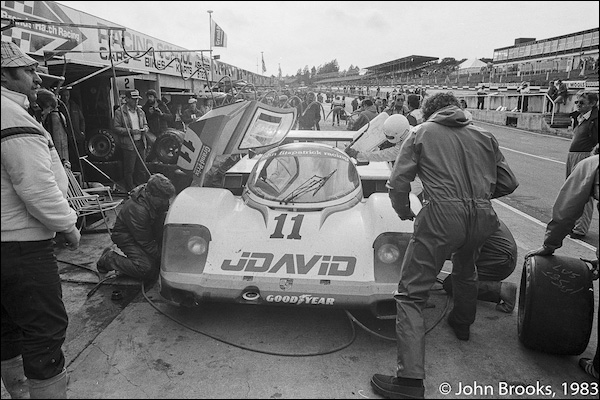
Le Mans, of course, was the big one. The first 956 had been delivered to JFR at Riverside, with Norbert Singer in attendance to help with the setting-up. It was not eligible for IMSA events (the 962, with its longer wheelbase, was prepared for American teams in 1984), so at the invitation of the SCCA he entered it in the Can-Am race at Elkhart Lake, which he won. It was subsequently shipped back to Europe.
There was one big win in the States, but it was a sad occasion. JFR entered two 935s in the Los Angeles Times Grand Prix at Riverside, one for Fitz and Hobbs, the other for Rolf Stommelen and Derek Bell. As it happened Dominelli made a rare appearance, bringing some important clients for the day.

During the first stint Stommelen was hit by a slow car and spun his 935, hitting the back end in the barrier. He continued, making a slow lap to check the car out, then got back up to race speed. Soon the rear wing collapsed, the car went out of control and the German was fatally injured.
Fitzpatrick did not know the consequence of the accident, and carried on. Bell was drafted to his car and the three drivers won the race outright, the third in this event for Fitz in four years. Of course there was no celebration, just sadness that one of the best drivers of the period had died, best-liked too.
John Fitzpatrick Racing entered two Porsches for Le Mans, the second one with backing from Guy Edwards who brought sponsorship from Skoal Bandit, the chewing tobacco company. Fitz had paid a 50,000 dollar deposit on the car and had a call three weeks before the event, telling him the car was ready for collection.

One problem. Dominelli had overlooked two reminders to pay the balance, and the deadline was approaching very quickly. The 956 was to be delivered to Joest who would paint it up, and take it to Le Mans. In desperation Fitz went to Dominelli’s office at six in the morning, to be told he had gone to London. Ten days before the race, Fitz took a BA flight to London and tracked Dominelli down to the Duke’s Hotel in Mayfair, his favoured resting place.
“Hey Fitz, how’s it going? What brings you here?” Fitz explained his mission briefly, stressing the absolute urgency of paying Porsche the balance.
“How much, John?” Oh, 200,000 dollars would complete the purchase. At that, Dominelli produced a crumpled piece of paper from his wallet, a spare blank cheque, made it out for $200,000 and with this, Fitz hastened back to Heathrow, caught the same plane back to Los Angeles and was just in time to reach the bank before it closed. Helpfully, the manager arranged for the money to be credited to JFR, and was then asked for one more thing: “Please wire this to Porsche in Stuttgart, right away.”
The new Porsche was a turn-key entry. There was no time to do any setting-up, no special preparation, but Edwards and Rupert Keegan enjoyed a serene race to fifth place overall, a brilliant result for a last-minute entry. Fitz’ own 956, shared with Hobbs and Dieter Quester, was an early retirement.
Which brings us to Brands Hatch, a round of the European Endurance Championship in September. It was a mostly wet event, drying, something that played into Fitzpatrick’s hands as he was using a special undertray on his 956, one that had been designed in San Diego. There were vents underneath the engine bay to release hot air, but these could safely be blocked for qualifying…and, Fitz reckoned, for a wet race on a cool day. Derek Warwick was signed to drive with Fitz, and he soon realised that he had more downforce than the Rothmans-Porsches, and every other car in the race.
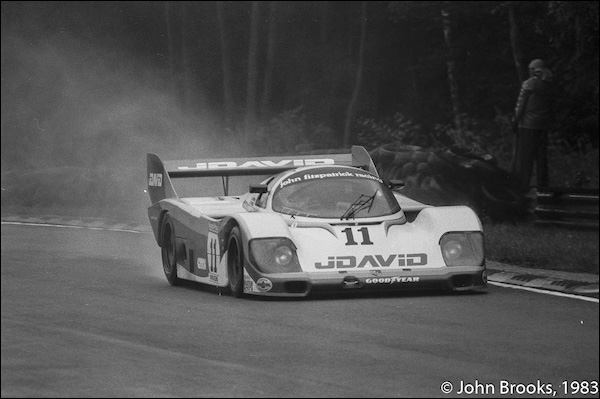
Warwick led, and although he was desperate for a toilet break after two stints, Fitzpatrick made him stay in the cockpit for a third spell, as the track was drying. Together, they made a bit of history, only the third Porsche customer team to beat the factory in a straight contest, and according to Fitzpatrick, Warwick reckons that it was this performance that raised Renault’s interest and got him his Formula One drive. On Goodyear tyres, they beat the factory Porsches by a clear lap, a margin almost beyond belief.
Still in 1983, Fitz was invited by Tom Walkinshaw to drive his Jaguar XJS in some ETC rounds. He and Martin Brundle won at Donington, but the next race, at Mugello, was the last that Fitz would contest for Walkinshaw. “Part of the driver briefing was how to access some extra fuel, if needed. We were up against all my pals in BMWs, Dieter Quester and so on, and after the race I told Tom I didn’t want to drive for him any more. He asked me why, I just said I wasn’t happy in the car. Tom was a great organiser, a great motivator, he picked the right guys and paid them well, but he could not lie straight in bed!”
Fitzpatrick’s last race as a driver was at Mugello in October 1983, when his 956 finished fourth in the European Championship race with Hobbs and Boutsen. It was just a month after his last big win, at Brands Hatch, and with that he retired from the cockpit at the age of 40. “It was a mistake to retire then” he reflects. “I was upset by Rolf’s accident, but when I saw Bell, and Wollek, still racing in the nineties I thought I could have been too.”
The third and final part of Michael Cotton’s account of this encounter will appear tomorrow.