

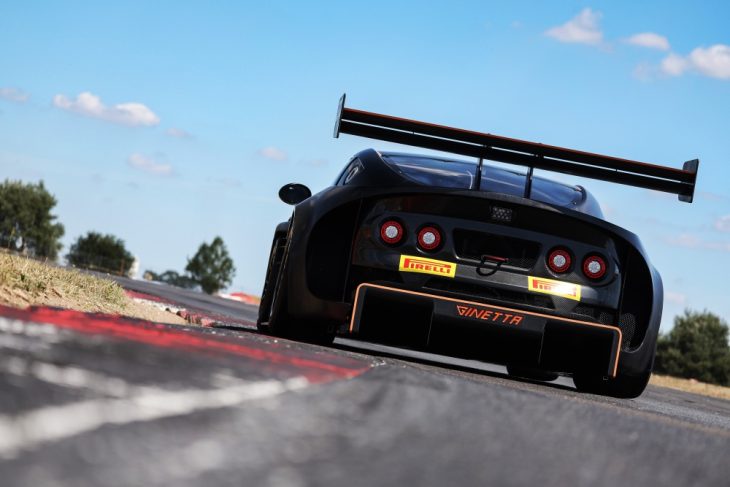

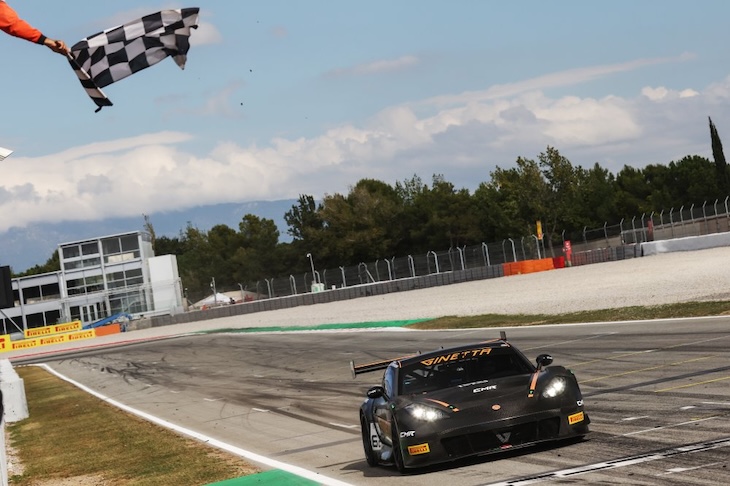
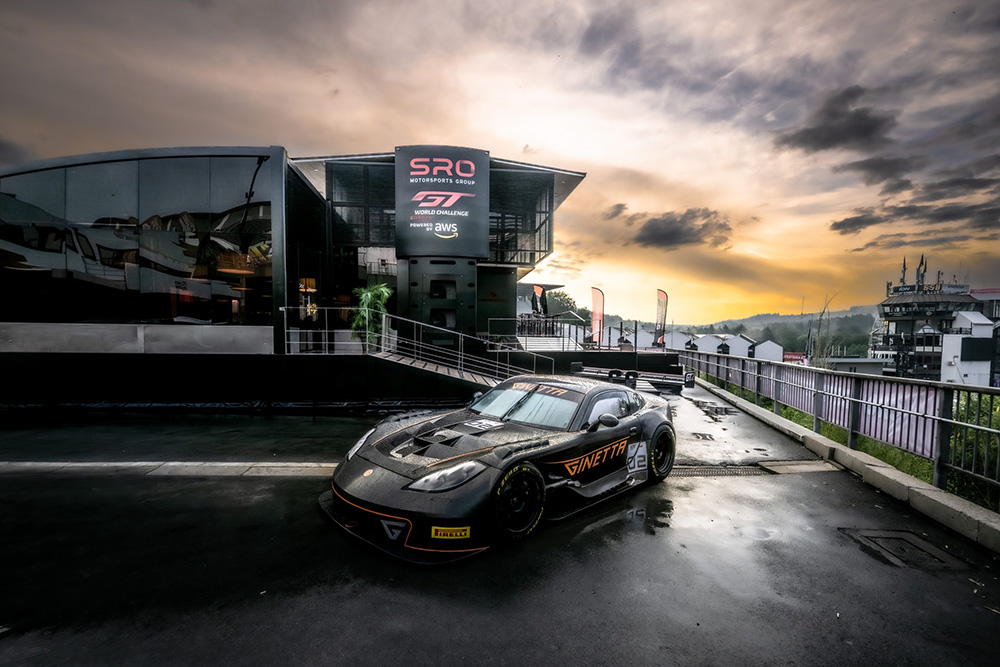
UK-based Ginetta has a reputation for helping drivers climb the progression ladder, from karting through its Juniors, right up to GT4 and LMP3. Now it is developing the ultimate step in its GT journey: the GT2, which achieved double podium success on debut in the GT2 European Series last weekend.
Based around the company’s G56 platform, this is an evolution of the GTX model released in 2024, with greater power, lower weight thanks to a full carbon body, and improved aerodynamics. However, this is not some simple upgrade pack – extensive work has been undertaken to optimise the chassis and engine to handle the added performance.
Some of the changes are regulation-specific to meet the SRO GT2 class rules. For example, the seating position needed to be fixed (Ginetta uses rail-mounted seats in most of its other cars), which entailed the addition of an adjustable pedal box to ensure adaptability from driver to driver.
Technical director Clive Seddon explains, “It’s easy to say add an adjustable box, but it was a horrendous amount of work because the pivots [of the G56 pedals] were part of the chassis. We have never had one except for in the P3 car. For the GT2, we would have loved to have spent a year developing a pedal box, but the project wouldn’t be on track now if that were the case. So we went for a Tilton box and brought the master cylinders inside the car. They have traditionally always been flange-mounted on the bulkheads.”
There have also been more fundamental changes to the chassis, due to the performance window the car will need to operate in. Seddon says that the most significant have centred around the anti-dive and anti-squat characteristics. “There is something inherent in Ginettas where the car pitches and dives around acceleration, which is great for an Am driver learning about car feel,” he notes.
However, with a more potent aerodynamic package, greater platform stability was required. Mike Simpson, CEO of Ginetta and also responsible for much of the company’s test driving duties, explains, “You can’t manage the aero platform. You hit the brakes and it’s pitching; it’s all or nothing on one end and it’s hard to maintain the balance.”
The fix needed to go beyond simple damper modifications. Seddon notes that third damper elements were considered, but in the end, revised suspension kinematics – which are still under development – provided the solution. He points out that there needs to be some compromises when it comes to adding anti-effects into the chassis. “Of course, when you add anti-squat, when you get off the throttle and onto the brakes, the rear wants to pop up. Then you end up back where you started, with the front going down.”
The G56 platform uses a tubular-frame chassis, which makes it much easier for the team to modify suspension mounting points and other areas to accommodate changes, compared with a carbon tub. It also helps that Ginetta has extensive in-house capabilities, from full machining through to fabrication and composites work. “We can move quite quickly to change things,” says Seddon.

Ginetta has taken what could be described as an old-school approach to development of the GT2, though this should not be regarded as a negative. Rather than simulating every tiny part of the car before building anything, the company just got on with fabrication and testing. This was helped by the fact that it has its own test track at Blyton Park, close to the factory, and knows the G56 base characteristics very well.
“When we have been taking on some of these unknowns [such as the kinematics], we have designed in versatility,” says Seddon. “Because in practice, we don’t want to sit behind a computer for 18 months doing simulation and Optimum K, then just start building a carbon monocoque. We want to get going, find the problems.”
The result is getting a car on track quickly to start pounding out the laps. This flexible approach has been taken across the car, from retaining old mounting points (on the prototype) to permit back-to-back testing of new and old suspension setups, through to adding in flexibility with the aerodynamics, cooling and engine. Seddon highlights, “As Lawrence [Tomlinson, owner of Ginetta] will always say, ‘We’ve got a track, we’ve got drivers, we’ve got fuel and tyres. Get the thing working and we’ll go find out its problems.’”
You’re not designing a car for pace; you’re designing a car knowing you are going to get BoP’d
It was important to ensure that the GT2 had the right character for the series and drivers. Seddon notes, “We didn’t want it to be a GT4 Evo with the thing on rails.” Instead, it needed to be quick in a straight line, easy on tyres and easy to drive. Seddon and Simpson are also alive to the fact that the series’ balance of performance (BoP) will have a huge influence once the vehicle is in competition, which means it is important to build as neutral a car as possible.
“We have to make it respond to the circus that is BoP,” says Seddon. In practice, this means that ride height changes must have a measurable and consistent impact on aero performance and lap time, with the same applying to weight addition or subtraction. What Ginetta wanted to avoid was having a car that was effectively immune to these changes, which would leave the series organisers with only one route to balancing the car’s performance against the rest of the field: removing power. “You’re not designing a car for pace; you’re designing a car knowing you are going to get BoP’d.”
Another significant development for the GT2 compared with the GTX and GT4 is the engine. For those cars, Ginetta relied on the stalwart Chevy LS3 platform, gradually building up power to the 580–600bhp range. However, Seddon says that was the limit: “Running at that power presented oodles of problems with that engine. We were starting to have issues with the crank bearings, fretting and things moving at the bottom end.” With the GT2 targeting higher power (in race trim, the LS3s hit around 530bhp reliably), it was clear a different solution was needed.
Ginetta could have turned to an established engine manufacturer such as Gibson for a bespoke unit, but fortunately, the answer was in its armoury all along. Back in 2016, Ginetta developed the G57 sports prototype, also using the LS3, but in that application the engine was used as a stressed member, which highlighted some of the same issues later encountered in the higher-power G56s. The answer then had been to develop a billet block in-house, retaining much of the LS3 architecture. “We thought, hang on a minute, we’ve got this old warhorse tucked away – let’s bring it out. So far, it has been solid,” reports Seddon.
The engine is very lightly supercharged, using a centrifugal blower, which was chosen for packaging and reliability reasons. The engine was well suited to forced induction, making over 790bhp at under 1 bar of boost; in its current trim, with just 0.3 bar, it is down to ‘only’ 650bhp. “We are literally wheezing at the engine,” remarks Seddon. “It responds so sensitively to boost; it’s not a 2.0-litre with a lot of boosts, or a mid-sized, 4.0-litre V8. It’s a 6.3-litre V8, so you breathe on it a little and off it goes!”
An important upshot of being able to run such low boost is that the charge cooling required is minimal, with only a small air-water cooler needed, which in turn has a knock-on benefit to the aerodynamic packaging.
The result of Ginetta’s efforts – at least judging by testing so far and the overall appearance of the car – is that it hits the GT2 brief on the head: a big, burly V8-engined coupe that goes like the wind.
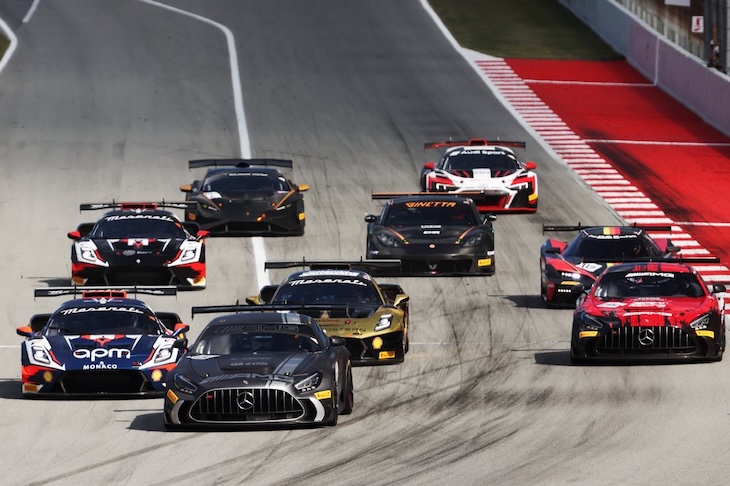
Add into that mix some highly competitive running costs (Simpson predicts these will be similar to the company’s GT4, at around US$7.70/km), albeit with more expensive bodywork if crashed, and engine rebuilds at around 9,000km, and it is an appealing package compared with some of its competition. Though the overall price has yet to be revealed, it is probably safe to assume it will be considerably lower than other GT2s such as the Maserati MC20 and Lamborghini Huracán.
Simpson is optimistic that the GT2 will be a good seller, although current plans are for only seven builds per year. “I think we will be in demand for these cars and not just for motorsport. There is also a big market for it outside of racing; the leisure market for trackdays, the race clubs and track resorts.”
DSC’s Butcher’s Block column series is powered by the industry-only PMW Expo in Cologne, which is set to take place this year on November 12th and 13th at the Köln Messe.
You can register your interest HERE and enquire about exhibiting HERE.
For more from Lawrence Butcher, you can download the latest issue of Professional Motorsport World Magazine HERE.


