
1. Triple Crown
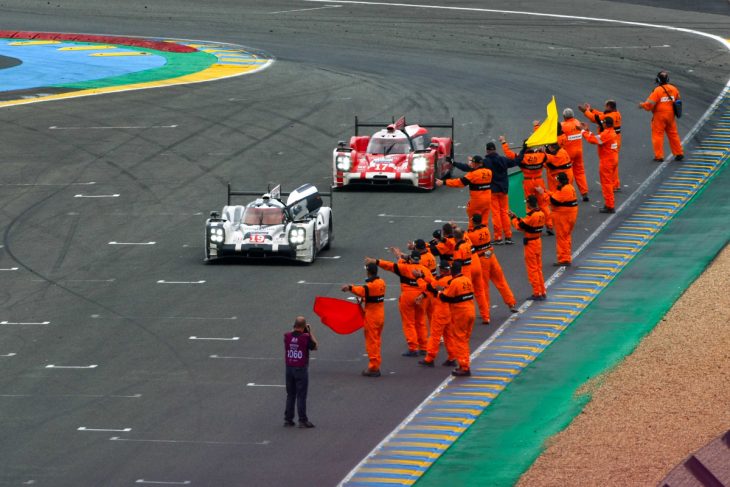
As has been deservedly well-publicised, Nick Tandy recently won sports car racing’s triple crown (Le Mans, Daytona and Sebring), to which he can also add victories in the Spa and Nurburgring 24 Hours.

It was noteworthy that the IMSA website agreed with my assessment that only nine drivers have previously achieved this feat.
In other words, IMSA concedes that winning one of the five Daytona races (1962-65 and 1972) which were shorter than 24 Hours does not amount to “winning Daytona” for the purpose of the triple crown. (If those five shorter races are included, then Gurney, Hill and Ickx need to be added to the list, such that Tandy would then be the 13th, not 10th, driver to complete the triple crown.)
It is an extraordinary and unprecedented achievement for a driver to have not only won the triple crown, but also the other major European 24 hour races at Spa and Nurburgring. Well played, sir!
2. Lietz joins select group
More than 700 drivers have taken a class victory in the race, but history shows that it’s a hard act to follow; for instance, just 75 drivers have won three or more class victories.

At the very top of the tree, just 11 drivers have won five or more class victories: Tom Kristensen (9); Claude Ballot-Lena (7); Jacky Ickx, Henri Pescarolo, Emanuele Pirro and Olivier Beretta (6); then Hans Herrmann, Derek Bell, Frank Biela, Oliver Gavin and now Richard Lietz with 5.
3. United nations
The country which has produced the most outright winning drivers is Great Britain, for whom James Calado was its 34th winner (if John Duff and Bernard Rubin are considered to be Canadian and Australian respectively, not British).

Thirty Frenchmen and 18 Germans (including West Germans) have won the race, while the recent heroics by Pier Guidi, Giovanazzi and Fuoco have taken Italy up into fourth place, ahead of America.
But special mention should be made of three small countries which have fought way above their weight in the history of the race: Belgium, Denmark and New Zealand.
4. Target for the Dames
If the Iron Dames can win LMGT3, they will be the third all-lady crew to have won their class in the history of the race.
Christine Beckers/Yvette Fontaine/Marie Laurent took their Chevron to a win in 2-litre Group 5 in 1974. Twelve months later, that same class was won by Michele Mouton/Marianne Hoepfner/Christine Dacremont, in a Moynet.
Women have claimed 13 class victories in the race to date.
5. Top heavy
Twenty-five marques have won Le Mans outright. Just ten marques have second as their best result, while eleven marques have third as their highest outright placing, this figure being bolstered in recent years by the addition of BR (2019), Glickenhaus (2022) and Cadillac (2023).
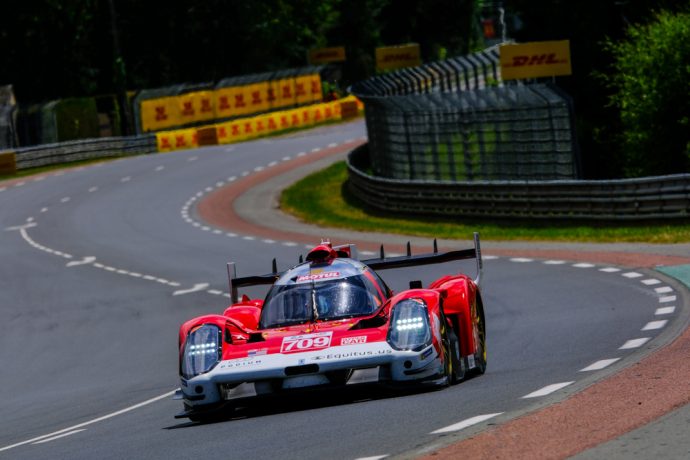
Despite those additions, it’s still a very unusual pattern of success: in a race with such a long history, it seems incongruous that more marques have won the race than the combined figure of marques which have second or third as their best result.
6. Upside down pyramid
This curious pattern continues lower in the top ten.

In 2024, Lamborghini became the 105th marque to claim a top ten outright result in the race; it is one of just five marques for which tenth is their best result in the race. But for seven marques, ninth is their best result; for eight marques, it is 8th; for nine marques it is 7th; and for 14 marques, it is 6th.
This pattern is the exact opposite of what could be expected; one would think that the better the result, the harder it is for a marque to achieve.
7. Generation gap
LMP2 driver Louis Délétraz (below) is the son of Jean-Denis Délétraz, who won his class in both 2001 and 2002. Louis has come extremely close to winning his class, but to date it eludes him.

Indeed, history shows how hard it is for a son to emulate his father’s feat of winning his class at Le Mans: it was first done by Louis & Jean-Louis Rosier, who were only followed by S.C.H. & Colin Davis, Edgar & Jürgen Barth, Bob & Al Holbert, Derek & Justin Bell, Wayne & Jordan Taylor, and Jean-Michel & Maxime Martin.
The Rosiers really stand out in this pack: not only are they the only father and son to ever share a car which won its class (1950), but for good measure they won that race outright. Louis, who was 44, called all the shots, allowing 25-year-old Jean-Louis to drive just two laps.
8. Long Jean
At 97, Jean Guichet is the longest-lived of all the outright winners, eclipsing 1926 victor Robert Bloch, who made it to 95. In 1964, Guichet and Nino Vaccarella took the last victory for a works Ferrari until the historic events of 2023.

9. Older and wiser
Jody Scheckter, who was severely criticised for causing a massive pile-up in the 1973 British GP when he was 23, observed later in his career that it was actually a far more meritorious goal to be the oldest, rather than the youngest, world champion.
Applying that approach to Le Mans, just four men can claim to be the oldest driver to win the race in its 102-year history.
André Lagache, 38, set the mark in the inaugural race in 1923, then S.C.H. Davis was 40 when he survived the melee at Maison Blanche to win the epic 1927 event. Earl Howe had just turned 47 when he won in 1931, while Luigi Chinetti was also 47, but close to turning 48, when he won the first race after the War.
Chinetti’s record has led a charmed life since 1949, as drivers of the calibre of Bob Wollek, Mario Andretti, Derek Bell and Rinaldo Capello have come tantalisingly close to breaking the longstanding mark on various occasions.
Indeed, if Wollek/Hélary/Andretti had won in 1995, which was well within their grasp, two drivers in their 50s would have won the race.
10. Echoes over the Atlantic
Remarkably, the oldest winner of another of the world’s classic races, the Indianapolis 500, was also 47.
In 1987, Al Unser combined his legendary skill and racecraft with a fairytale series of events which enabled him to claim his fourth victory in the 500. He turned 48 five days after the race.
Even more coincidentally (at least at first glance…) Le Mans and Indianapolis share not only the age of their oldest winner, but also of their youngest. As noted above, Fontés (1935), Amon (1966) and Wurz (1996) all won Le Mans when they were 22. The youngest driver to (officially) win the Indy 500 is Troy Ruttman, who was 22 when he triumphed in 1952. Bill Vukovich, who clearly had Ruttman’s measure, retired from the lead nine laps from the flag, leaving Ruttman to take the last win at Indianapolis for a dirt-track car.
But just like Le Mans, which likes to ignore the inconvenient truth of how it decreed that pole position would be awarded for the 1980 and 1991 races, Indianapolis has curiously managed to persuade itself that the relief drivers in the early years didn’t really “win” the race. For instance, in 1911, Cyrus Patschke drove the winning Marmon Wasp for a very strong stint of about 35 laps while Ray Harroun (who freely admitted he couldn’t manage the 500 miles by himself) had a rest.
Patschke was 21 at the time. He was never formally acknowledged as a winner of that race, ostensibly because Harroun had both started and finished the race, while Patschke’s stint was in the middle. This somewhat perverse approach not only denied Patschke his place in posterity as a victor of one of the world’s great races, but also deprived him of the honour of being the youngest driver to ever win the 500, a title he would otherwise have held for the last 114 years.